 Recycling and pelletizing
9 types
Recycling and pelletizing
9 types
 Extrusion
8 types
Extrusion
8 types
 Mixing equipment
2 types
Mixing equipment
2 types
 Conveying and storage
8 types
Conveying and storage
8 types
 Drying and cooling
2 types
Drying and cooling
2 types
 Cutting, pressing and packaging
4 types
Cutting, pressing and packaging
4 types
 Plastic processing machinery
3 types
Plastic processing machinery
3 types
 Electromechanical equipment
7 types
Electromechanical equipment
7 types
 Miscellaneous machinery
11 types
Miscellaneous machinery
11 types
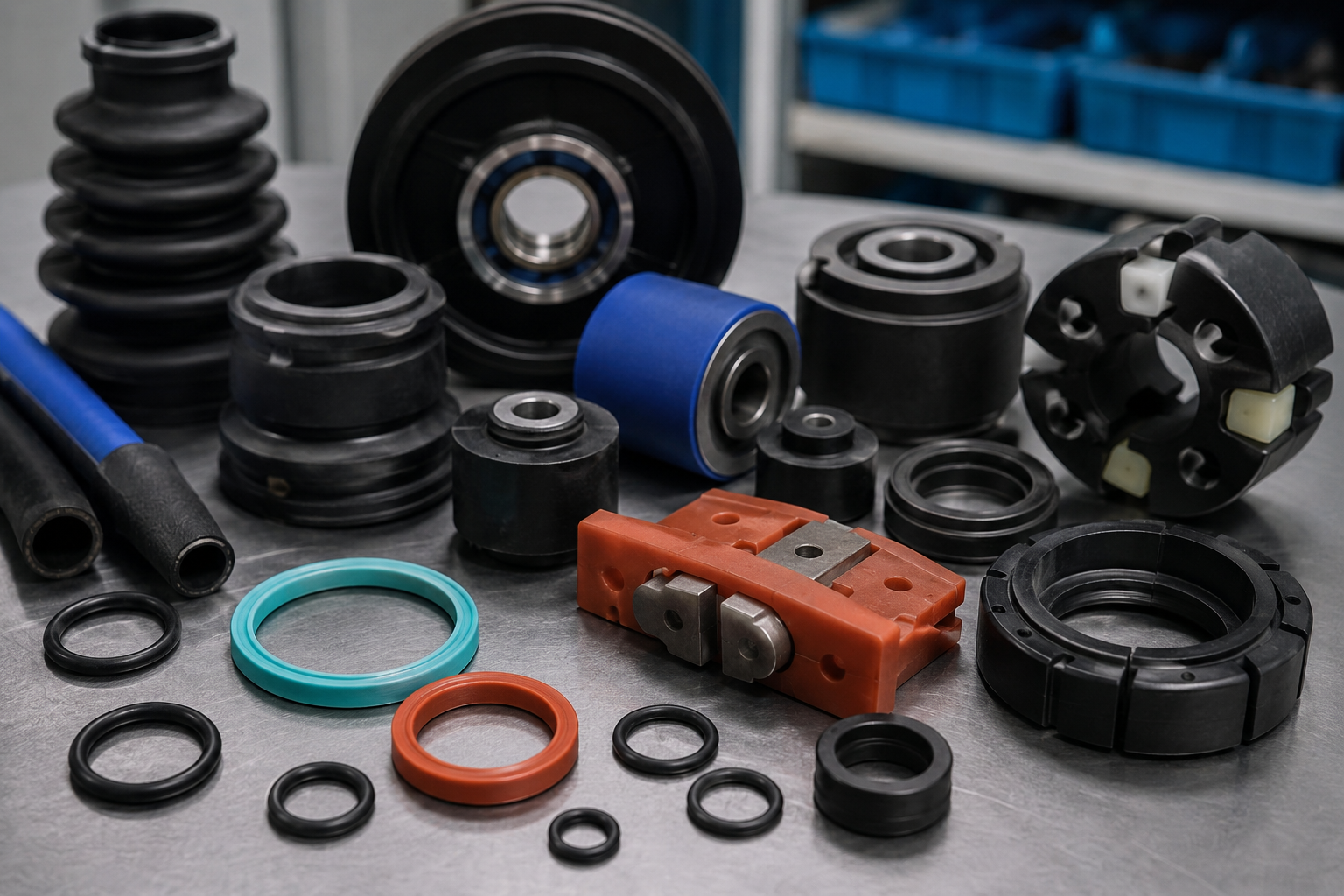
An elastomer is a polymer material capable of undergoing significant deformation and then largely returning to its original shape. In other words, it is a material that provides flexibility, shock absorption, sealing properties, and elastic behavior in situations where rigid plastic or metal would not be suitable. It is therefore commonly found in seals, bushings, hoses, coatings, couplings, technical wheels, and many industrial components.
Although it is often associated with plastics, its behavior is actually different. An elastomer is not defined only by its chemical composition, but mainly by how it reacts to mechanical stress, temperature, friction, and aging. This characteristic makes it essential in technical applications where elasticity is a key function.
What Is an Elastomer?
An elastomer is a type of polymer capable of deforming under stress and then returning to a shape close to its original state once the load is removed. This property makes it a key material in many industrial applications.
Simple Definition
In simple terms, an elastomer is a flexible material designed for parts that must compress, stretch, or absorb vibrations without breaking or becoming rigid like conventional plastic.
Elastomer Polymer: What Does This Term Mean?
An elastomer polymer belongs to the polymer family, meaning materials composed of long molecular chains. Its internal structure allows it to deform and then return to its original shape, which explains its elastic behavior.
Main Properties of Elastomers
- High elasticity and deformation capability
- Partial or total return to original shape
- Absorption of vibrations and shocks
- Good sealing capability
- Variable resistance depending on formulations
- Adaptation to mechanical stress
Behavior of Elastomer Materials
Elasticity and Shape Recovery
An elastomer material can be compressed, stretched, or bent and then return to its original shape. This capability is essential in sealing and damping applications.
Mechanical Resistance and Flexibility
Elastomers combine flexibility and mechanical resistance. They can withstand repeated deformation, moderate impacts, and continuous stress depending on their composition.
Thermal and Chemical Behavior
Depending on the type of elastomer, resistance to temperature, oils, solvents, or outdoor conditions may vary significantly. The choice of material therefore depends directly on its operating environment.
Thermoplastic and Thermosetting Elastomers
What Is a Thermoplastic Elastomer?
A thermoplastic elastomer can be melted and reshaped like conventional plastic. This facilitates industrial processing and sometimes recycling.
What Is a Thermosetting Elastomer?
A thermosetting elastomer, once vulcanized or cured, can no longer be remelted. It often provides better stability in service but is less easily recyclable.
Which Type Should Be Chosen?
The choice depends on the requirements: fast industrial production and recyclability for thermoplastics, performance and stability for thermosetting materials.
Main Types of Elastomers
Polyurethane Elastomer
Polyurethane is highly resistant to wear and abrasion. It is used in technical wheels, rollers, mechanical parts, and components subjected to heavy stress.
Silicone Elastomer
Silicone offers excellent thermal and chemical resistance. It is used in seals, insulation, and demanding environments.
EPDM, NBR, and Other Compounds
- EPDM: resistance to weather, ozone, and UV rays
- NBR: resistance to oils and fuels
- FKM: high chemical and thermal performance
Industrial Applications of Elastomers
Seals and Tightness
Elastomers are widely used to ensure sealing in industrial, hydraulic, and pneumatic systems.
Bushings, Silent Blocks, and Dampers
They help absorb vibrations, reduce shocks, and improve machine lifespan.
Flexible Hoses and Coatings
Elastomer materials are also used in flexible hoses, protective coatings, and technical components subjected to deformation.
Elastomers in the Plastics Industry
Elastomers occupy a special position between rigid plastics and soft materials. Some can be processed like engineering plastics, especially thermoplastic elastomers.
They are therefore often used in technical parts where flexibility and resistance must be combined.
Advantages and Limitations of Elastomers
Advantages
- High flexibility
- Shock and vibration absorption
- Good sealing properties
- Adaptability to complex shapes
Limitations
- Aging depending on the environment
- Sensitivity to certain chemicals
- Possible permanent deformation depending on stress conditions
Industrial Processing and Manufacturing
Main Processes
- Molding
- Injection molding
- Extrusion
- Vulcanization
Quality Control
Quality control is essential to guarantee the performance of elastomer parts, particularly in terms of hardness, elasticity, and mechanical resistance.
Choosing the Right Elastomer
According to the Application
The choice depends on the function of the part: sealing, damping, protection, or transmission.
According to the Environment
Temperature, chemicals, humidity, and mechanical stress strongly influence material selection.
According to Lifespan and Cost
It is important to find a balance between performance, cost, and component lifespan.
Importance of Elastomers in Industry
Elastomers play an essential role in modern industry. They help secure systems, improve machine reliability, and ensure critical functions such as sealing and damping.
Without them, many mechanical, hydraulic, and industrial systems could not operate reliably and durably.