 Recycling and pelletizing
9 types
Recycling and pelletizing
9 types
 Extrusion
8 types
Extrusion
8 types
 Mixing equipment
2 types
Mixing equipment
2 types
 Conveying and storage
8 types
Conveying and storage
8 types
 Drying and cooling
2 types
Drying and cooling
2 types
 Cutting, pressing and packaging
4 types
Cutting, pressing and packaging
4 types
 Plastic processing machinery
3 types
Plastic processing machinery
3 types
 Electromechanical equipment
7 types
Electromechanical equipment
7 types
 Miscellaneous machinery
11 types
Miscellaneous machinery
11 types
 What Is Industrial Lubrication and What Is It Used For?
Industrial lubrication includes all the techniques and products used to create a protective film between moving metal surfaces in order to reduce friction, wear, and overheating.
In an industrial environment, it is not just a maintenance element: it directly influences machine availability, process stability, and production costs.
An Essential Role in Machine Performance
Industrial lubricant allows equipment to operate under optimal conditions for longer, reducing downtime, breakdowns, and the degradation of critical components such as bearings, gearboxes, gears, chains, or mechanical screws.
Proper lubrication does not “repair” a machine: it preserves its performance and prevents progressive degradation.
Functions of Industrial Lubricants
Industrial lubricants are not just slippery fluids. They have specific technical properties: viscosity, additives, thermal stability, and resistance to aggressive environments.
Reduction of Friction and Wear
The lubricant creates a film between surfaces to prevent direct metal-to-metal contact. Without this film, wear accelerates, causing micro-scratches, vibrations, and mechanical failures.
Thermal Control and Protection
Lubrication helps stabilize component temperature and can even remove heat in circulating systems. It also protects against corrosion and oxidation.
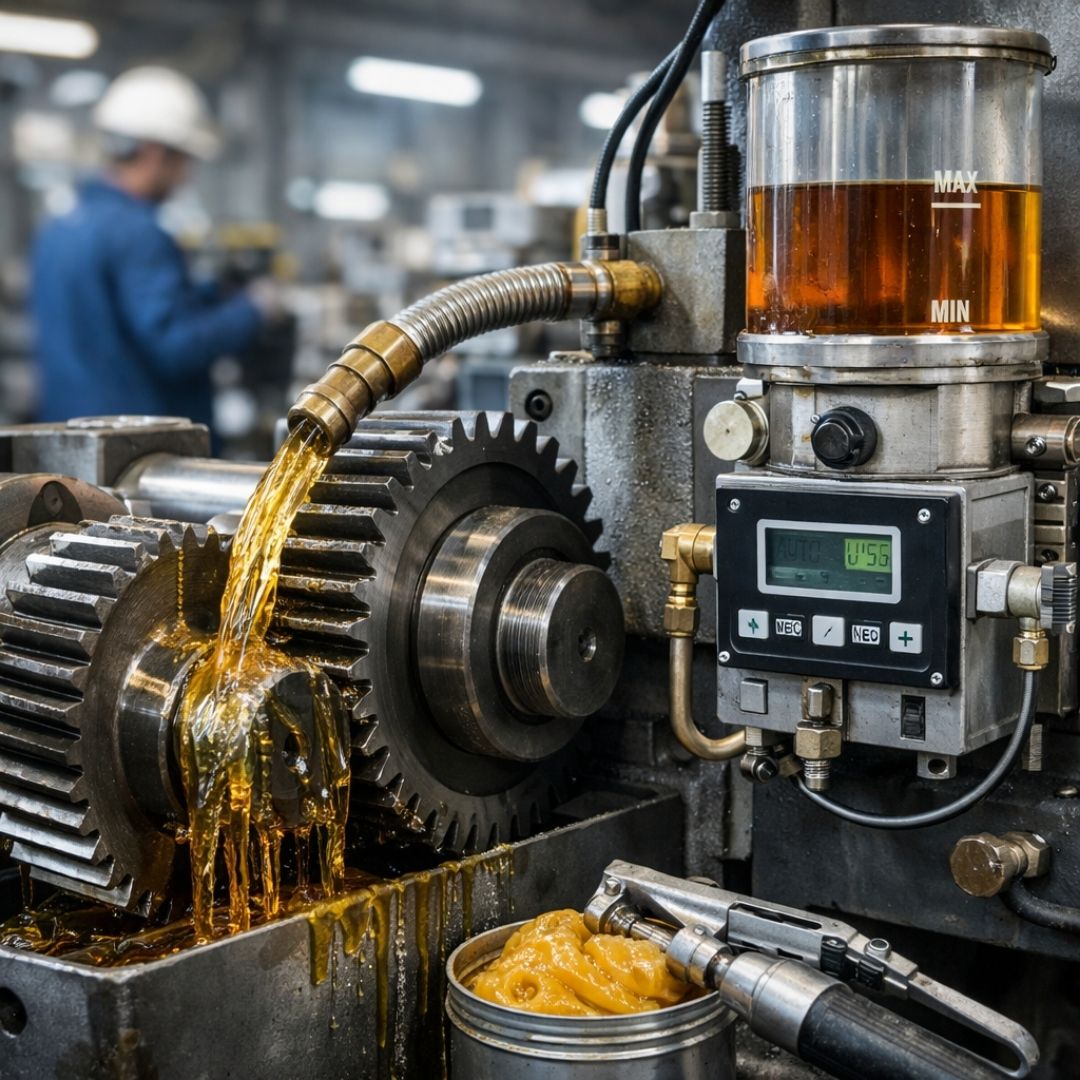
Industrial Lubrication Systems
Lubrication systems are used to store, distribute, and apply lubricant in a controlled way. They ensure proper dosing, frequency, and cleanliness.
The Key Elements of a System
- Lubricant storage tank or cartridge
- Distribution pumps, pipes, and valves
- Application lubrication points, nozzles, and circuits
- Control pressure, flow, filtration, and alarms
Types of Lubrication Systems
Manual Lubrication
This consists of manually applying oil or grease to friction points. It remains common but depends heavily on human discipline, which creates significant variations.
Automatic and Centralized Lubrication
These systems ensure a regular and controlled supply of lubricant. They reduce human errors, improve safety, and optimize consumption.
Bath, Splash, or Circulation Systems
Used especially in gearboxes and transmission systems, these methods allow continuous or semi-continuous lubrication depending on thermal and mechanical requirements.
Importance in Industrial Maintenance
Good lubrication is one of the pillars of preventive maintenance. It helps reduce breakdowns, stabilize performance, and extend equipment service life.
In many cases, repeated failures do not come from the mechanics themselves but from incorrect or insufficient lubrication.
Types of Industrial Lubricants
Industrial Oils
Used in gearboxes, hydraulic systems, and circulation circuits, they are mainly characterized by their viscosity and stability.
Industrial Greases
Composed of oil, a thickener, and additives, they are used for bearings and points requiring long-lasting lubrication. An incorrect quantity or incompatibility can lead to major failures.
Lubricants for the Food Industry
Designed to meet strict hygiene standards, they resist water, frequent washing, and sensitive environments.
Impact on Machine Service Life
Lubrication directly influences the service life of industrial equipment. Poor management accelerates wear and reduces reliability, while a good strategy helps stabilize performance over the long term.
In demanding environments such as recycling or processing, it becomes a critical productivity factor.
Common Mistakes in Industrial Lubrication
- Excess lubricant, especially grease
- Choosing an unsuitable product
- Incorrect lubrication frequency
- Contamination by dust or water
- Incompatibility between products
- Lack of monitoring and control
Effective Lubrication Strategy
An effective lubrication strategy is based on product standardization, clear routine definition, lubrication point control, and intervention traceability.
When properly integrated into maintenance, lubrication becomes a major reliability driver, reducing unexpected downtime and maintenance costs.
Conclusion
Industrial lubrication is not a secondary task: it is an essential discipline for ensuring machine performance and longevity. When properly managed, it turns maintenance into a true tool for reliability and productivity.