 Recycling and pelletizing
9 types
Recycling and pelletizing
9 types
 Extrusion
8 types
Extrusion
8 types
 Mixing equipment
2 types
Mixing equipment
2 types
 Conveying and storage
8 types
Conveying and storage
8 types
 Drying and cooling
2 types
Drying and cooling
2 types
 Cutting, pressing and packaging
4 types
Cutting, pressing and packaging
4 types
 Plastic processing machinery
3 types
Plastic processing machinery
3 types
 Electromechanical equipment
7 types
Electromechanical equipment
7 types
 Miscellaneous machinery
11 types
Miscellaneous machinery
11 types
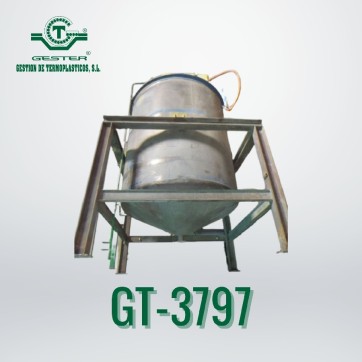
TANKS AND HOPPERS
Used Industrial Tanks and Hoppers
At Gester, we offer a selection of used industrial tanks and hoppers designed for storing, receiving and supplying raw materials throughout production processes. These machines are widely used in plastics, recycling, food processing, chemicals, pharmaceuticals, agriculture and other industries where powders, granules, pellets, flakes or liquids must be handled efficiently.
Industrial Storage Solutions for Production Lines
Tanks and hoppers form an essential part of many conveying and storage machinery installations. They provide a controlled storage point between material reception, preparation and processing, helping production lines maintain a more stable and organised material flow.
Industrial hoppers are generally used to receive and temporarily store bulk solids such as plastic pellets, regrind, powders, granules, flakes, grains and additives. Their lower discharge opening allows the material to be released by gravity or transferred through an auger, conveyor, rotary valve or pneumatic conveying system.
Industrial tanks can be used for storing liquids, powders or granular materials, depending on their construction and configuration. Available models may include vertical tanks, cylindrical vessels, stainless-steel tanks, polyethylene tanks, pressure vessels and units equipped with outlets, valves or agitation systems.
What Is an Industrial Hopper?
An industrial hopper is a container designed to receive bulk material and deliver it gradually to another machine or process. Its sloped or conical lower section helps direct the product towards a discharge outlet, reducing unnecessary accumulation inside the unit.
Hoppers are commonly installed above or beside production machinery to create a continuous feed. Once the material leaves the storage unit, dosing and loading equipment can regulate the amount delivered to extruders, mixers, packaging systems or other processing machines.
The appropriate hopper design depends on the characteristics of the stored material. Powders, sticky products, abrasive substances and lightweight flakes may require different wall angles, outlet dimensions or discharge systems to prevent bridging, blockages and irregular flow.
What Is an Industrial Tank?
An industrial tank is used to store, hold or process liquids, powders and other materials under controlled conditions. Tanks may be incorporated into production lines for temporary storage, ingredient preparation, liquid transfer, wastewater handling or the collection of processed materials.
The construction material should be compatible with the product being stored. Stainless steel may be preferred for hygienic, corrosive or temperature-sensitive applications, while carbon steel or plastic tanks can provide suitable solutions for other industrial uses.
Important characteristics include tank capacity, wall thickness, material of construction, outlet position, access points, internal finish and compatibility with pumps, valves, mixers and conveying systems.
Tanks and Hoppers for Mixing Processes
In production lines where several ingredients, additives or recycled materials must be combined, tanks and hoppers can supply material directly to industrial mixers. This configuration helps maintain a consistent feed and reduces the amount of manual material handling required before the mixing stage.
For applications that combine storage and blending within a single system, companies may also consider mixing silos. These machines are particularly useful when large quantities of pellets, powders, flakes or other bulk materials must be homogenised before entering the next production process.
The most suitable configuration will depend on whether the material only needs to be stored, requires continuous agitation or must be mixed in batches. Production capacity, recipe accuracy and discharge speed should also be considered.
Material Discharge and Transfer Systems
Tanks and hoppers can be connected to screw conveyors, belt conveyors, vacuum loaders, pneumatic transport systems or gravity-fed outlets. Selecting the correct discharge method is essential for maintaining a consistent flow and preventing interruptions in downstream machinery.
Liquid-handling installations may also require oil, water and vacuum pumps to move products between tanks, processing equipment and collection points. The pump capacity, pressure and material compatibility must match the characteristics of the liquid and the requirements of the installation.
For solid materials, the outlet may be fitted with a rotary valve, slide gate, dosing screw or vibrating discharge device. These components help regulate material flow and can reduce the risk of uncontrolled release into the next machine.
Applications of Industrial Tanks and Hoppers
Used tanks and hoppers can be incorporated into many types of industrial processes, including:
- Plastic processing: Storage and feeding of pellets, masterbatch, additives, flakes and regrind.
- Plastic recycling: Collection and transfer of shredded, washed, dried or granulated materials.
- Food production: Storage of powders, grains, ingredients, liquids and semi-finished products.
- Chemical processing: Handling of compatible liquids, powders and industrial compounds.
- Agriculture and biomass: Storage of grains, feed, pellets and other bulk products.
- Water treatment: Collection, storage and transfer of liquids during treatment processes.
Benefits of Buying Used Tanks and Hoppers
Purchasing second-hand industrial storage equipment can reduce the investment required to expand or modify a production line. Used tanks and hoppers may also be available more quickly than new units manufactured according to custom specifications.
- Lower acquisition cost: Used equipment can provide a more economical alternative to purchasing a new storage system.
- Faster availability: Units already in stock may be incorporated into a facility with shorter lead times.
- Flexible integration: Tanks and hoppers can often be connected to existing conveyors, pumps, mixers and dosing systems.
- Wide range of capacities: Available equipment may include compact feeding hoppers and larger industrial storage vessels.
- More sustainable investment: Reusing industrial machinery extends its service life and reduces the demand for newly manufactured equipment.
How to Choose the Right Tank or Hopper
Selecting suitable equipment requires an evaluation of the material being stored and the way it will be discharged. Capacity alone is not sufficient, as the unit must also be compatible with the product characteristics and surrounding machinery.
- Material type: Determine whether the unit will store liquids, pellets, powders, flakes or other bulk products.
- Required capacity: Calculate the storage volume needed to maintain the desired production rate.
- Construction material: Verify compatibility with abrasive, corrosive, hygienic or temperature-sensitive products.
- Outlet configuration: Check the dimensions and position of the discharge opening.
- Flow characteristics: Consider whether the material is free-flowing, sticky, lightweight or prone to compaction.
- Installation space: Review the overall dimensions, support structure and required discharge height.
- Connection requirements: Confirm compatibility with conveyors, loaders, pumps, mixers or processing equipment.
Frequently Asked Questions
Explore our available used industrial tanks and hoppers to find a practical solution for storing, feeding and transferring materials within your production line. Contact Gester for current availability, technical specifications, photographs or assistance selecting suitable equipment.
Last blog articles
Industrial Machinery Transport in Spain: Safe and Efficient Solutions
What Is an Extruder, How Does It Work, and What Is It Used For ?
HDPE or High-Density Polyethylene: What Is It, Properties, and Uses
Screw Compressor: What Is It, How It Works, Types, and Advantages
Indirect extrusion: what it is, how it works, and applications
See all