
 Recycling and pelletizing
9 types
Recycling and pelletizing
9 types
 Extrusion
8 types
Extrusion
8 types
 Mixing equipment
2 types
Mixing equipment
2 types
 Conveying and storage
8 types
Conveying and storage
8 types
 Drying and cooling
2 types
Drying and cooling
2 types
 Cutting, pressing and packaging
4 types
Cutting, pressing and packaging
4 types
 Plastic processing machinery
3 types
Plastic processing machinery
3 types
 Electromechanical equipment
7 types
Electromechanical equipment
7 types
 Miscellaneous machinery
11 types
Miscellaneous machinery
11 types
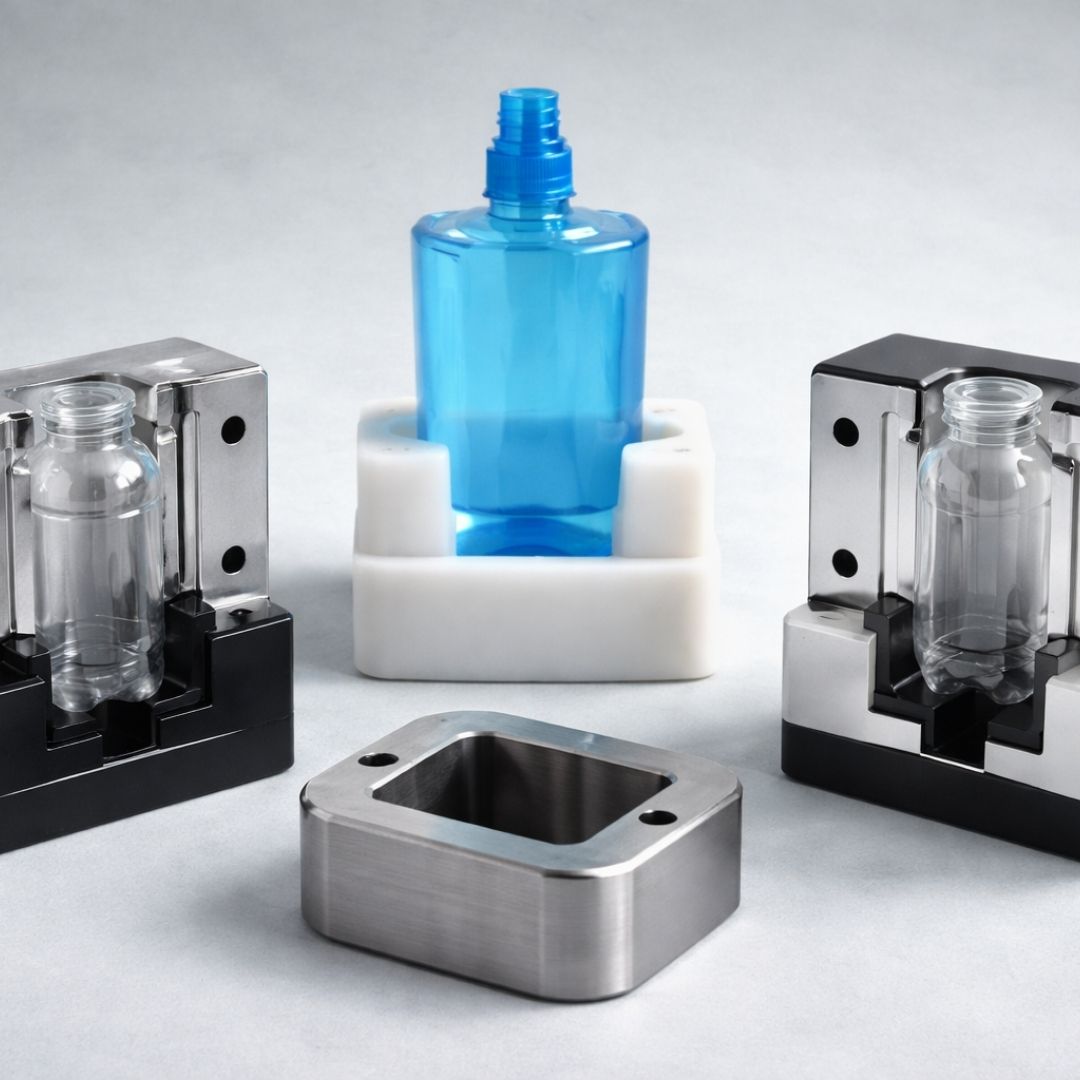 Plastic Blow Molding: Process and Applications
Plastic blow molding is one of the most widely used industrial manufacturing processes for producing hollow plastic parts with high precision and productivity. It is commonly used for bottles, containers, tanks, technical reservoirs, automotive components, industrial packaging, and many other applications where lightweight structures, airtightness, and complex shapes are required.
In modern plastics processing, blow molding has become a strategic technology because it allows manufacturers to combine productivity, material optimization, and dimensional consistency in large-scale industrial production.
What Is Plastic Blow Molding?
Plastic blow molding is a manufacturing process used to produce hollow plastic parts by inflating heated plastic material inside a mold cavity. The process relies on air pressure to force the softened material against the mold walls until the final geometry is achieved.
This technology is particularly suitable for manufacturing lightweight hollow products with controlled thickness and good mechanical performance.
Blow molding shares many similarities with industrial plastic extrusion, especially in the way thermoplastic materials are heated, melted, and shaped during production.
How Blow Molding Works
The blow molding process follows several sequential industrial stages designed to ensure repeatability and stable product quality.
Material Preparation
The process begins with the preparation of thermoplastic raw materials, generally in pellet form. The polymer is heated until it reaches a molten or softened state suitable for shaping.
The choice of material directly affects the final product’s flexibility, impact resistance, transparency, chemical resistance, and durability.
Formation of the Parison or Preform
A tube of molten plastic, called a parison, or a preform depending on the process type, is produced before entering the mold.
This intermediate shape becomes the base material that will later be inflated to create the final hollow product.
Mold Closing and Air Injection
The mold closes around the parison or preform, sealing the material inside the cavity. Compressed air is then injected into the plastic structure.
The internal pressure forces the material against the mold walls, reproducing the exact geometry of the final product.
Cooling and Stabilization
After forming, the plastic part is cooled inside the mold in order to stabilize its dimensions and mechanical properties.
Proper cooling control is critical to avoid shrinkage defects, deformation, or thickness inconsistencies.
Part Ejection
Once cooled and stabilized, the finished product is removed from the mold and prepared for trimming, inspection, packaging, or additional processing operations.
Main Types of Blow Molding
Several industrial blow molding technologies exist, each adapted to specific production requirements.
Extrusion Blow Molding
Extrusion blow molding is one of the most common methods. In this process, molten plastic is extruded continuously into a parison before being inflated inside the mold.
This method is widely used for industrial containers, tanks, drums, bottles, and technical hollow components.
Injection Blow Molding
Injection blow molding combines injection molding and blow molding in a single process. A preform is first injection molded before being reheated and inflated.
This technology offers excellent dimensional precision and high-quality surface finishes.
Stretch Blow Molding
Stretch blow molding is mainly used for PET packaging applications such as beverage bottles. The preform is stretched mechanically and inflated simultaneously, improving mechanical strength and transparency.
Materials Used in Blow Molding
Several thermoplastic materials are commonly used in blow molding depending on the intended application.
Polyethylene (PE)
Polyethylene is widely used because of its flexibility, impact resistance, and chemical stability.
Polypropylene (PP)
Polypropylene offers good rigidity, thermal resistance, and lightweight performance for industrial packaging and technical components.
PET (Polyethylene Terephthalate)
PET is especially common in transparent packaging and beverage containers due to its clarity and mechanical performance.
Technical Polymers
Some industrial applications require engineering plastics with enhanced chemical, thermal, or mechanical resistance.
To better understand the behavior of these materials, it is useful to study the classification of different types of plastics used in industrial processing.
Industrial Applications of Blow Molding
Packaging Industry
Blow molding is heavily used in the packaging sector for producing bottles, containers, drums, and industrial storage solutions.
Automotive Industry
In the automotive sector, blow molding is used to manufacture ducts, reservoirs, fuel tanks, and air management components.
Industrial Technical Parts
The process is also suitable for manufacturing technical hollow parts requiring dimensional consistency and mechanical resistance.
Consumer Products
Many consumer goods use blow molding technology for lightweight hollow products with optimized production costs.
Blow Molding Equipment
Industrial blow molding lines require several integrated systems working together in synchronization.
Extrusion Systems
Extruders prepare and melt the thermoplastic material before forming the parison.
The different types of extrusion machines used in plastics processing influence production stability and final product quality.
Blow Molds
The mold defines the geometry, dimensions, and surface finish of the final product.
Air and Pressure Systems
Compressed air systems are responsible for inflating the molten material uniformly inside the mold cavity.
Cooling Systems
Cooling units stabilize the material and reduce production cycle times.
Advantages of Blow Molding
Blow molding offers several important industrial advantages:
- High production speed
- Efficient manufacturing of hollow parts
- Reduced material consumption
- Lightweight final products
- Good dimensional consistency
- Cost-effective mass production
The process is particularly attractive when large production volumes and stable repeatability are required.
Challenges and Process Limitations
Despite its advantages, blow molding also presents several technical challenges.
Thickness Control
Maintaining uniform wall thickness can be difficult, especially in complex geometries.
Cooling Management
Improper cooling may cause shrinkage, deformation, or internal stress.
Material Compatibility
Not all thermoplastics behave identically during blow molding. Material selection must consider melt strength, thermal behavior, and processing stability.
Mold Design Complexity
Mold design plays a major role in final part quality, production speed, and defect prevention.
Blow Molding and Industrial Automation
Modern blow molding lines increasingly integrate automation systems to improve production efficiency and process consistency.
Robotics, conveyors, inspection systems, and automated handling devices help reduce manual intervention and improve productivity.
This integration is part of the broader evolution of plastic product manufacturing equipment toward highly automated industrial environments.
Quality Control in Blow Molding
Quality control is essential to guarantee dimensional stability, airtightness, visual appearance, and mechanical resistance.
Typical inspections include:
- Wall thickness measurement
- Leak testing
- Visual inspection
- Weight consistency
- Mechanical testing
- Dimensional verification
Stable process control helps reduce waste, defects, and production interruptions.
Conclusion
Plastic blow molding is a highly efficient industrial manufacturing process for producing hollow thermoplastic parts with precision, consistency, and productivity.
Its ability to manufacture lightweight yet durable products makes it essential in industries such as packaging, automotive manufacturing, industrial equipment, and consumer products.
When properly controlled, blow molding combines material optimization, high production capacity, automation compatibility, and strong economic performance, making it one of the most important technologies in modern plastics processing.