 Recycling and pelletizing
9 types
Recycling and pelletizing
9 types
 Extrusion
8 types
Extrusion
8 types
 Mixing equipment
2 types
Mixing equipment
2 types
 Conveying and storage
8 types
Conveying and storage
8 types
 Drying and cooling
2 types
Drying and cooling
2 types
 Cutting, pressing and packaging
4 types
Cutting, pressing and packaging
4 types
 Plastic processing machinery
3 types
Plastic processing machinery
3 types
 Electromechanical equipment
7 types
Electromechanical equipment
7 types
 Miscellaneous machinery
11 types
Miscellaneous machinery
11 types
 Plastic Coextrusion: Industrial Process, Materials, and Applications
Plastic coextrusion has become a strategic solution within the plastics industry. When products must simultaneously provide resistance, flexibility, sealing performance, barrier properties, or long-term durability, a single-layer structure is often no longer sufficient.
In this context, coextrusion makes it possible to manufacture multilayer materials by combining several polymers within a single product. The process relies on the same principles as industrial plastic extrusion, but with a more advanced approach focused on performance optimization and material efficiency.
What Is Plastic Coextrusion?
Coextrusion consists of extruding several materials simultaneously and assembling them within a single die in order to form a unified multilayer structure. Each layer maintains a specific function: rigidity, flexibility, adhesion, chemical resistance, mechanical protection, or sealing capability.
Unlike single-layer extrusion, which uses only one polymer, coextrusion distributes performance requirements across several layers. It therefore becomes particularly useful when technical constraints are too demanding to be covered by a single material.
How Does a Coextrusion Line Work?
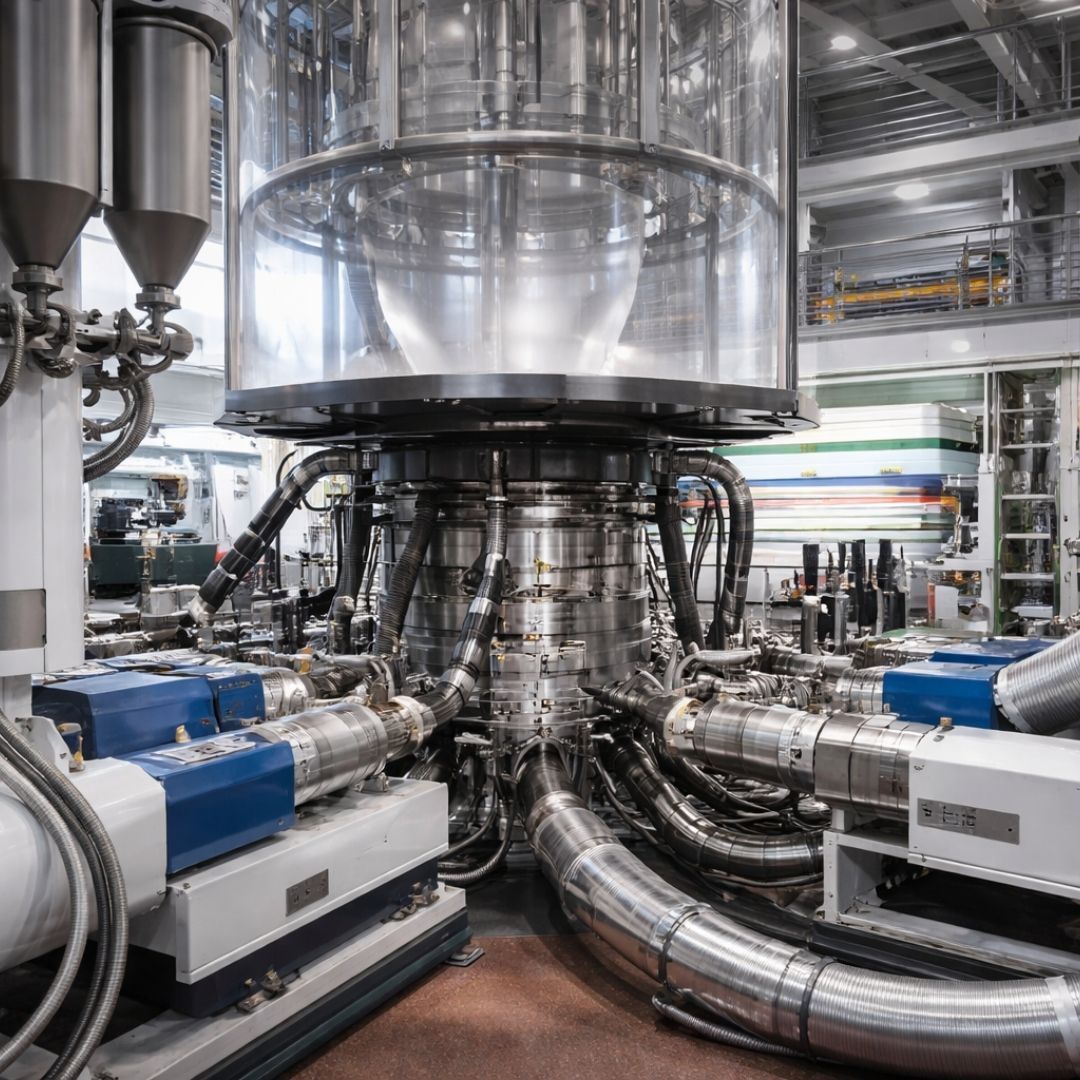
An industrial coextrusion process relies on multiple extruders operating in parallel. Each polymer is individually prepared, heated, and dosed before being combined inside a multilayer coextrusion die.
The selection of equipment depends on the product being manufactured, the materials used, and the required level of precision. To better understand the possible configurations, it is useful to know the different types of machines used in coextrusion.
Material Feeding and Preparation
Each material is introduced into a dedicated extruder. This independence allows precise control over the temperature, throughput, and processing speed of each polymer.
Stable feeding conditions are essential. Conveying, mixing, grinding, or separation systems may be integrated to obtain homogeneous and stable material flow, particularly when recycled materials are incorporated into the formulation.
Layer Assembly
The different material streams meet inside the coextrusion die. They are not mixed together, but instead superposed according to a predefined structure.
The design of the die is critical because it directly influences layer order, thickness, adhesion, and the dimensional stability of the final product.
Cooling and Calibration
Once the structure is formed, the product is cooled and calibrated in order to guarantee dimensions, surface quality, and final performance properties.
Poor control during this stage may generate defects, internal stresses, or dimensional instability.
Differences Between Single Extrusion and Coextrusion
Single-layer extrusion remains suitable for relatively simple technical products where one material is capable of meeting all application requirements. It is generally more economical and easier to implement.
Coextrusion, on the other hand, is used when the product must combine several properties that are difficult to achieve with a single polymer. It allows manufacturers to combine rigidity and flexibility, chemical resistance and sealing properties, or mechanical performance and aesthetic finishing within the same product.
It is considered one of the most advanced plastic extrusion technologies when the objective is to design high value-added products.
Industrial Applications of Coextrusion
Multilayer Films and Sheets
Coextrusion is widely used for manufacturing technical films and sheets intended for packaging, thermoforming, or specific industrial applications. These structures may integrate barrier layers, sealing layers, or protective outer surfaces.
In this sector, plastic sheet and film extrusion lines play a central role, especially for multilayer technical materials.
Technical Pipes
Coextruded pipes combine external protection, mechanical resistance, and chemical barrier properties. They are used in demanding environments, particularly in industrial sectors, construction, and fluid transport systems.
Functional Profiles
Coextruded profiles make it possible to integrate several functional zones within a single part: rigid sections, flexible sections, technical surfaces, or sealing areas. This reduces assembly operations and simplifies manufacturing processes.
Equipment Used in Coextrusion
Extruders form the core of the process. single-screw extruders for plastic materials are frequently used for processing standard polymers with stable throughput.
For more complex formulations, fillers, technical blends, or certain recycled materials, twin-screw extruders for technical plastics provide better mixing capability and improved process control.
Material Selection
The success of a coextrusion project strongly depends on polymer compatibility. When two materials do not naturally adhere to each other, it may be necessary to introduce a tie layer or a specific adhesive component.
Thermoplastic elastomers are frequently used to provide flexibility, improve sealing performance, or create a functional interface between more rigid materials.
Advantages of Coextrusion
Coextrusion optimizes raw material usage because each polymer is placed only where it provides technical value. It may also reduce manufacturing stages, improve product performance, and lower certain production costs.
The process also offers considerable design freedom, since the product structure can be adapted precisely to its intended final application.
Limitations and Process Challenges
Coextrusion requires highly precise adjustment of temperatures, flow rates, pressures, and processing speeds. Any imbalance between layers may generate adhesion defects, delamination, or dimensional variations.
Differences in material shrinkage must also be anticipated during the design stage in order to avoid deformation after cooling.
When Should Coextrusion Be Used?
Coextrusion is particularly suitable when the expected performance exceeds the capabilities of a single material. It allows manufacturers to design multilayer products that are more efficient, more durable, and better adapted to industrial requirements.
When properly controlled, this technology becomes a true product design tool capable of improving final quality while optimizing material usage and industrial performance.