 Recycling and pelletizing
9 types
Recycling and pelletizing
9 types
 Extrusion
8 types
Extrusion
8 types
 Mixing equipment
2 types
Mixing equipment
2 types
 Conveying and storage
8 types
Conveying and storage
8 types
 Drying and cooling
2 types
Drying and cooling
2 types
 Cutting, pressing and packaging
4 types
Cutting, pressing and packaging
4 types
 Plastic processing machinery
3 types
Plastic processing machinery
3 types
 Electromechanical equipment
7 types
Electromechanical equipment
7 types
 Miscellaneous machinery
11 types
Miscellaneous machinery
11 types
 Industrial Machines: Definition, Role, and Importance in a Factory
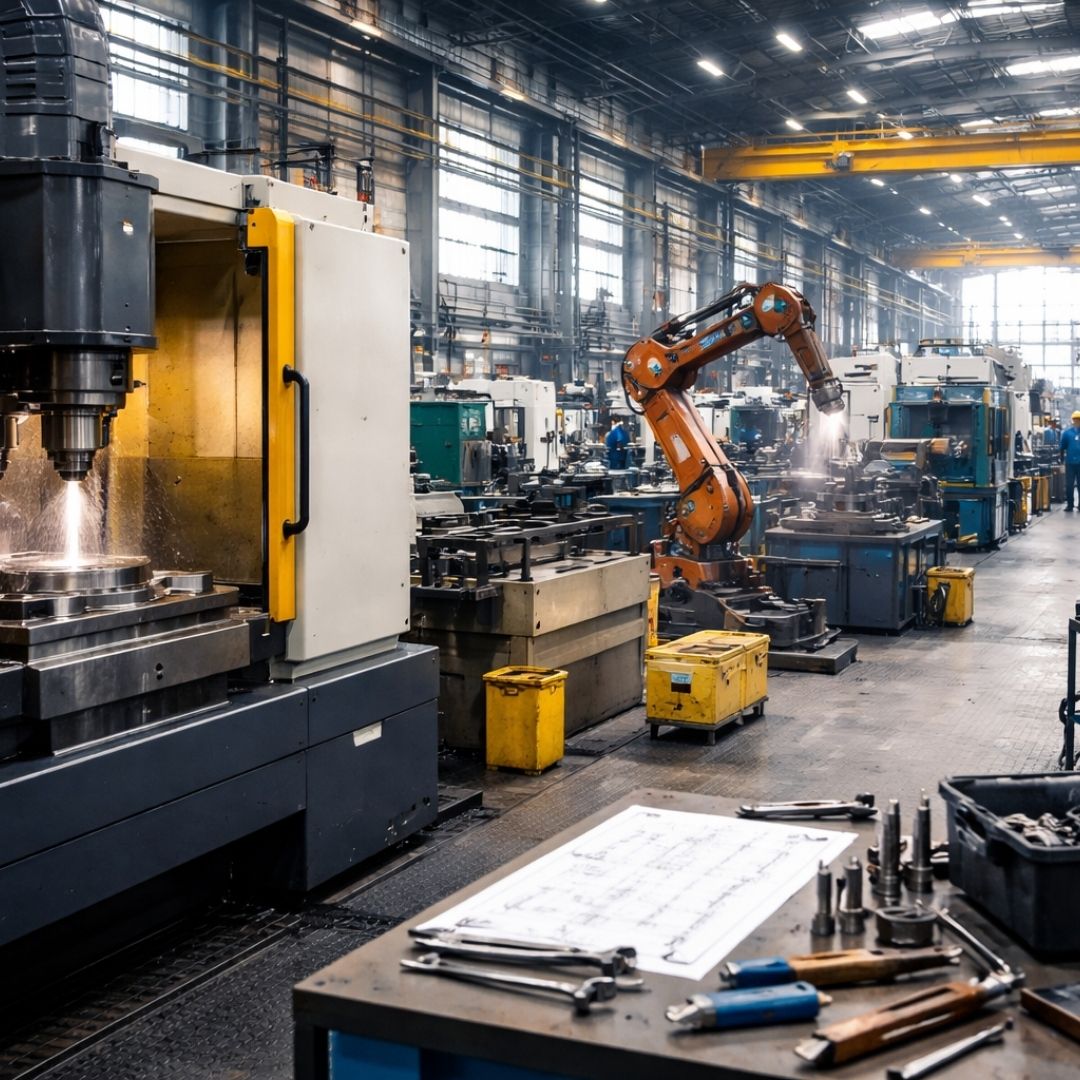
Industrial machines include all mechanical, electrical, hydraulic, pneumatic, or automated equipment used to perform production operations in a stable, repeatable, and safe manner.
In a factory, they make it possible to transform raw materials, move loads, control technical parameters, automate repetitive tasks, package products, or maintain a constant production rate.
Their role is essential: improving productivity, ensuring quality, reducing line stoppages, and maintaining continuity in the industrial process.
What Is Industrial Machinery?
Industrial machinery refers to a set of machines, mechanisms, auxiliary equipment, and control systems designed to perform a productive task with requirements for capacity, precision, safety, and continuity.
An industrial line does not depend only on the main machine. It may include conveyors, electrical cabinets, hydraulic systems, safety devices, cooling equipment, extraction systems, automation systems, and sensors used in industrial machines.
Industrial machinery must therefore be understood as a complete production system rather than an isolated machine.
Difference Between Industrial Machine and Industrial Equipment
The difference between an industrial machine and industrial equipment is mainly functional.
Industrial Machines
Industrial machines perform the main operation of the process: cutting, shredding, mixing, extruding, injecting, forming, machining, filling, packaging, or transforming raw material.
Industrial Equipment
Industrial equipment supports or enables this operation. It may include compressors, auxiliary conveyors, chillers, extraction systems, measuring instruments, electrical cabinets, or safety devices.
A high-performance main machine is not enough if the auxiliary equipment is poorly sized or poorly maintained. In such cases, the consequences can be significant: productivity losses, quality defects, unexpected stoppages, or higher maintenance costs.
Types of Industrial Machines
Industrial machines can be classified according to their function, technology, or the sector in which they are used.
Classification by Function
- Processing machines
- Material handling and internal transport machines
- Industrial packaging machines
- Industrial cleaning machines
- Quality control machines
- Industrial maintenance machines
Classification by Technology
- Mechanical machines
- Hydraulic machines
- Pneumatic machines
- Electric or servo-driven machines
- CNC machines
- Automated systems with PLCs
Examples of Industrial Machines by Sector
Industrial machines are used in almost all productive sectors. In the metal industry, they include presses, shears, lathes, milling machines, and CNC machining centers. In the food industry, they are involved in mixing, cooking, dosing, filling, and packaging.
In the plastics sector, industrial machines are essential for recycling, processing, and material recovery. Shredders, sorting lines, conveying systems, extruders, and washing plants make it possible to transform plastic waste into reusable materials.
Extrusion processes play a central role in this industry. Industrial equipment for plastic extrusion makes it possible to transform plastic material into pellets, profiles, films, or other formats adapted to new industrial applications.
Industrial Machines in Plastic Recycling
In plastic recycling, industrial machinery must meet several objectives: reducing waste volume, separating materials, removing contaminants, washing plastics, drying them, extruding them, and preparing the material for reuse.
The most common equipment includes shredders, granulators, conveyors, washing lines, separators, centrifuges, compactors, and extruders.
Industrial recycling and pelletizing machines play a key role in this process because they make it possible to recover plastic waste and reintroduce it into new production cycles.
Components, Critical Parts, and Consumables
The availability of an industrial machine does not depend only on its design. It also depends on the condition of its components, wear parts, and consumables.
- Critical parts: their failure can cause a complete line stoppage.
- Important parts: they influence process quality, precision, or stability.
- Consumables: they must be replaced regularly according to the actual use of the machine.
Bearings, belts, blades, filters, seals, oils, sensors, and hydraulic elements must be monitored carefully in order to reduce unexpected failures and extend equipment lifespan.
Industrial Machine Maintenance
Maintenance is one of the most important factors in ensuring the reliability of an industrial machine. A well-maintained machine preserves its precision, limits production stoppages, and reduces repair costs.
There are several approaches: corrective, preventive, predictive, and condition-based maintenance. Industrial maintenance and the role of the technician are therefore essential for detecting anomalies, organizing interventions, and keeping the production line in proper operating condition.
Lubrication is also one of the most important maintenance actions. Properly controlled industrial machine lubrication systems reduce wear, limit overheating, and help extend the lifespan of mechanical components.
Common Inspection Points
- Abnormal vibrations
- Bearing temperature
- Belt tension and alignment
- Condition of hydraulic systems
- Oil cleanliness
- Wear of cutting or friction parts
- Operation of sensors and safety devices
Installation, Assembly, and Commissioning
The installation of an industrial machine directly influences its future performance. Poor leveling, incorrect alignment, or improperly executed connections can cause vibrations, premature wear, or production defects.
Proper installation must include floor inspection, positioning, leveling, alignment, electrical, pneumatic or hydraulic connections, safety tests, and production trials.
Industrial Transport and Reinstallation
Transporting an industrial machine requires precise planning. Disassembly, component protection, loading, logistics, unloading, and reinstallation must be carried out carefully to avoid mechanical or electrical damage.
When a machine is moved from one factory to another, it is recommended to document connections, protect sensitive elements, and plan a testing phase after reinstallation.
Industrial Safety
Safety is a central element in the use of industrial machines. Physical guards, emergency stops, sensors, locking systems, signage, and lockout procedures reduce risks for operators.
A productive but dangerous machine represents an operational, human, and legal risk. Safety must therefore be integrated from installation and regularly verified throughout the equipment’s lifespan.
Retrofit, Modernization, and Revamping
When an industrial machine becomes obsolete, it is not always necessary to replace it completely. In some cases, retrofit and industrial machine modernization make it possible to improve performance, safety, automation, or energy efficiency of existing equipment.
- Retrofit: partial upgrading of a machine, often at the electrical, electronic, or automation level.
- Revamping: more complete modernization of a production line or productive system.
These interventions can reduce energy consumption, increase precision, simplify maintenance, and extend the lifespan of the machine.
Lifespan and Depreciation
The lifespan of an industrial machine depends on many factors: manufacturing quality, intensity of use, working environment, maintenance, spare parts availability, and operator training.
Depreciation should not be evaluated only from the purchase price. Productivity, downtime costs, energy consumption, ease of maintenance, and spare parts availability must also be considered.
Training of Operators and Technicians
A high-performance industrial machine requires well-trained operators and technicians. Training must cover proper machine operation, safety procedures, adjustments, routine inspections, and early signs of failure.
A trained operator detects anomalies more quickly, reduces handling errors, and helps extend the lifespan of the equipment.
Used Industrial Machines
Purchasing used industrial machines can be a strategic decision to reduce initial investment while maintaining good production capacity.
Before purchasing, it is important to evaluate the real condition of the machine, its maintenance history, spare parts availability, operating hours, automation level, and modernization possibilities.
It is also necessary to analyze production requirements, space constraints, energy consumption, maintenance costs, and machine integration within the existing production line.
Conclusion
Industrial machines are at the heart of modern production. They make it possible to transform materials, automate processes, improve quality, reduce cycle times, and maintain factory competitiveness.
Their performance does not depend only on the main machine. It also depends on auxiliary equipment, installation, maintenance, safety, training, and investment strategy.
Understanding the types of industrial machines, their role, and their maintenance makes it possible to make better technical and economic decisions, whether purchasing a new machine, modernizing an existing line, or integrating a used solution into a production process.