 Recycling and pelletizing
9 types
Recycling and pelletizing
9 types
 Extrusion
8 types
Extrusion
8 types
 Mixing equipment
2 types
Mixing equipment
2 types
 Conveying and storage
8 types
Conveying and storage
8 types
 Drying and cooling
2 types
Drying and cooling
2 types
 Cutting, pressing and packaging
4 types
Cutting, pressing and packaging
4 types
 Plastic processing machinery
3 types
Plastic processing machinery
3 types
 Electromechanical equipment
7 types
Electromechanical equipment
7 types
 Miscellaneous machinery
11 types
Miscellaneous machinery
11 types
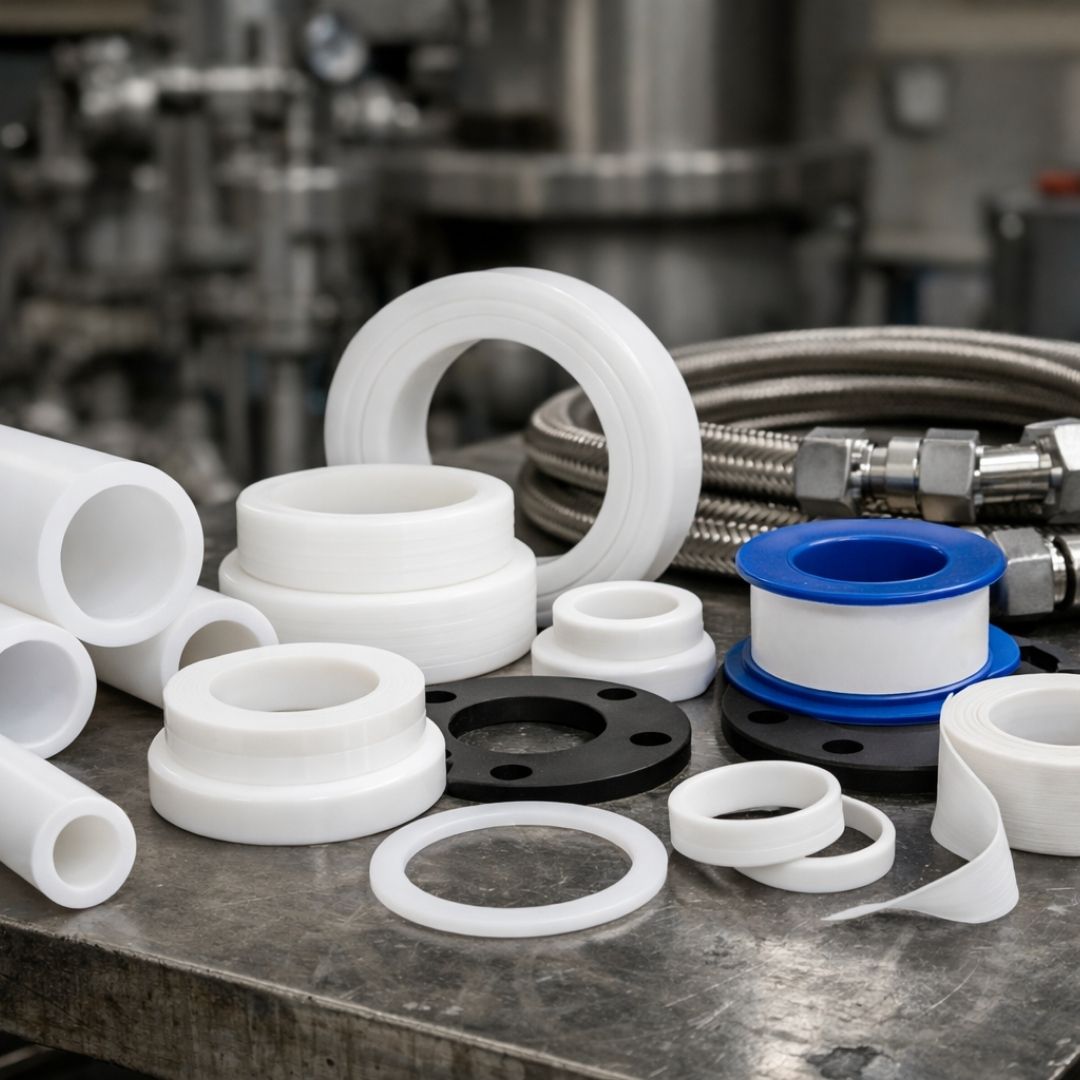
PTFE, also commonly known as Teflon, is one of the most widely used materials in industrial environments where resistance, stability, and reliability are essential. Although many people associate it only with kitchen utensils, it is actually a high-performance technical material found in sectors such as the chemical industry, automotive, machinery, and industrial equipment manufacturing.
When we talk about PTFE material, we are referring to a polymer with very specific properties: extreme chemical resistance, low friction coefficient, thermal stability, and non-stick behavior. These characteristics make it an essential material in applications where other plastics fail or degrade easily.
What Is PTFE?
PTFE is a synthetic polymer belonging to the fluoropolymer family. It stands out for its highly stable structure, which allows it to maintain its properties even under extreme conditions of temperature, pressure, or chemical exposure. In practice, this means it is designed to work where other materials cannot be used.
In industry, understanding this material is not only theoretical: it is a technical choice. Using it means prioritizing stability, durability, and resistance in critical applications where failure is not an option.
What Is Polytetrafluoroethylene?
The technical term for PTFE is polytetrafluoroethylene, a polymer formed by the repetition of tetrafluoroethylene units. Its chemical formula is (C₂F₄)n, and its behavior is based on the very strong bond between carbon and fluorine, which gives it exceptional resistance to chemical and thermal agents.
This molecular structure explains why this material does not react easily, does not degrade easily, and maintains its properties even in aggressive environments. That is why it is widely used in demanding industrial applications.
PTFE and Teflon: Are They the Same Thing?
A common question is whether PTFE and Teflon are identical. The answer is simple: PTFE is the material, while Teflon is a trademark that popularized this polymer. In other words, all Teflon is PTFE, but not all PTFE is necessarily Teflon.
In industry, the technical term is mainly used, although both concepts are often associated in searches.
PTFE Material: Characteristics and Technical Properties
PTFE Properties in Industrial Applications
PTFE stands out for its chemical resistance, its ability to withstand high temperatures, and its non-stick nature. It is practically inert to most chemicals, making it an ideal solution for corrosive environments.
It can also operate across a wide temperature range without losing stability, and its low friction coefficient reduces wear on moving parts.
Thermal and Mechanical Behavior
PTFE can withstand high temperatures without significant deformation. Mechanically, it offers good dimensional stability, although it is not the most rigid of technical polymers.
Its main strength lies in its ability to operate under extreme conditions rather than in pure mechanical resistance.
Why PTFE Is a Unique Material
The combination of its properties makes it difficult to replace. It is not simply a plastic, but a technical solution for specific challenges: corrosion, friction, temperature, or contamination.
That is why its use is based more on technical necessity than on cost.
Uses of Polytetrafluoroethylene in Industry
Applications in the Chemical and Mechanical Industries
In the chemical industry, it is used for pipes, valves, and seals exposed to corrosive substances. In mechanical applications, it is found in parts exposed to friction or aggressive environments.
PTFE in Sealing Systems
PTFE gaskets and sealing tapes are widely used to prevent leaks in industrial fluid systems, ensuring reliability and safety.
Use in Filtration and Membranes
PTFE is used in membranes and filters thanks to its chemical resistance and stability, especially in processes requiring high purity.
Industrial PTFE Coatings
PTFE coating is applied to surfaces to reduce friction, prevent adhesion, and improve the chemical resistance of industrial equipment.
Formats and Products Made With PTFE
PTFE Tubes and Hoses
PTFE tubes and hoses are used to transport aggressive or high-temperature fluids.
PTFE Tape: What Is It Used For?
PTFE tape is mainly used to seal threads and fittings in order to prevent leaks in installations.
Expanded PTFE and Advanced Materials
Expanded PTFE offers greater flexibility and better adaptability to irregular surfaces.
Differences Between PTFE and Other Plastics
PTFE vs. Conventional Thermoplastics
PTFE offers better chemical and thermal resistance than most plastics, but it is more expensive and more difficult to process.
Advantages Compared to Other Technical Polymers
Its main advantage is its stability under extreme conditions, which reduces the risk of failure and maintenance costs.
PTFE and PFOA: Safety and Industrial Reality
Is PTFE Toxic?
Under normal industrial use conditions, PTFE is stable and safe. Concerns often relate to substances associated with its manufacturing, not to the final material.
Difference Between PTFE and PFOA
PFOA is an agent used in certain manufacturing processes, while PTFE is the final product. They should not be confused.
Safe Use of PTFE
When used correctly, PTFE is a reliable material, provided that the technical conditions of use are respected.
How PTFE Is Processed in Industry
Manufacturing Processes
PTFE is processed through sintering and machining because it cannot be molded like conventional thermoplastics.
Recycling Limitations
PTFE recycling is complex compared to other plastics, which limits certain recovery applications.
When to Choose PTFE
PTFE is chosen when chemical resistance, thermal stability, or low friction must be guaranteed. In other cases, less expensive alternatives may be preferred.
Equipment for Processing Industrial Plastic Materials
If you need equipment to process technical materials, it is possible to acquire industrial machines or used machines adapted to your needs. Choosing the right equipment is essential to guarantee process efficiency and the quality of the final product.