 Recycling and pelletizing
9 types
Recycling and pelletizing
9 types
 Extrusion
8 types
Extrusion
8 types
 Mixing equipment
2 types
Mixing equipment
2 types
 Conveying and storage
8 types
Conveying and storage
8 types
 Drying and cooling
2 types
Drying and cooling
2 types
 Cutting, pressing and packaging
4 types
Cutting, pressing and packaging
4 types
 Plastic processing machinery
3 types
Plastic processing machinery
3 types
 Electromechanical equipment
7 types
Electromechanical equipment
7 types
 Miscellaneous machinery
11 types
Miscellaneous machinery
11 types
What Industrial Sensors Are and Why They Are Essential in Today’s Industry
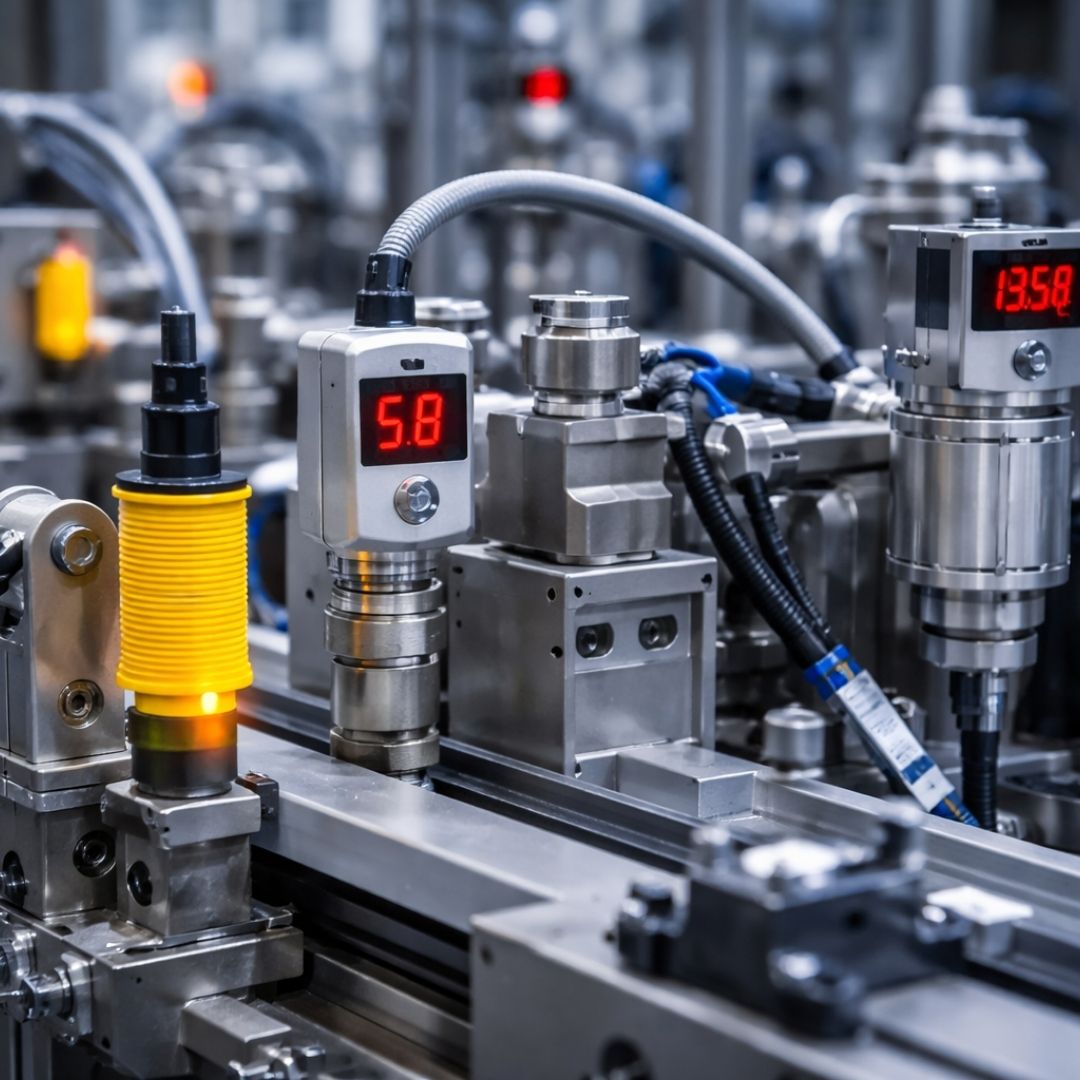
Industrial sensors are devices designed to detect, measure, and convert physical variables from the production environment into useful signals for control systems. They are critical components for ensuring the stability, safety, and continuity of industrial machines.
In modern industrial environments, they enable precise process control, greater reliability, and the anticipation of problems before they affect production.
Without sensors, machines operate without reliable data, which increases the risk of breakdowns and quality losses.
What Sensors Are Used For in Industry
Sensors play a central role in process control and in the protection of equipment and operators.
Main Functions
- Monitoring critical variables such as temperature, pressure, level, and speed
- Machine safety and controlled shutdowns
- Energy optimization
- Prevention of mechanical failures
- Production stability
Types of Industrial Sensors According to Their Function
Temperature Sensors
Used in thermal processes such as extrusion, heating, or cooling.
Pressure Sensors
They monitor hydraulic and pneumatic systems to prevent overpressure and ensure facility safety.
Level Sensors
They control material levels in silos, hoppers, and tanks in order to prevent overflows or production stoppages.
Proximity Sensors
They detect the presence of objects without contact and are used for positioning and machine safety.
Vibration and Speed Sensors
They make it possible to monitor machine condition and anticipate mechanical failures.
Types of Sensors According to Technology
- Inductive sensors
- Capacitive sensors
- Photoelectric sensors
- Ultrasonic and infrared sensors
Applications in Industrial Machines
Examples of Use
- Shredding: load, temperature, vibration
- Extrusion: pressure and temperature
- Conveying: detection and positioning
- Material sorting: flow control
- Quality control: measurement and verification
Sensors and Industrial Automation
Sensors are essential for automation. They provide the data needed by control systems to perform precise actions in real time.
Sensors and Industry 4.0
Smart sensors enable real-time monitoring and the development of predictive maintenance through the analysis of collected data.
Modernization of Industrial Machines
Sensors can be integrated into existing equipment to improve performance without replacing the mechanical structure, following an industrial retrofit approach.
Advantages of Industrial Sensors
- Improved process control
- Reduction of unplanned downtime
- Increased safety
- Optimization of energy consumption
- Measurable return on investment