 Recycling and pelletizing
9 types
Recycling and pelletizing
9 types
 Extrusion
8 types
Extrusion
8 types
 Mixing equipment
2 types
Mixing equipment
2 types
 Conveying and storage
8 types
Conveying and storage
8 types
 Drying and cooling
2 types
Drying and cooling
2 types
 Cutting, pressing and packaging
4 types
Cutting, pressing and packaging
4 types
 Plastic processing machinery
3 types
Plastic processing machinery
3 types
 Electromechanical equipment
7 types
Electromechanical equipment
7 types
 Miscellaneous machinery
11 types
Miscellaneous machinery
11 types
 Industrial Machine Retrofit: What It Really Means
Talking about industrial machine retrofit does not simply mean repairing an old machine. In an industrial environment, retrofit consists of extending the service life of existing equipment by improving its reliability, safety, maintainability, and performance.
In many cases, this approach makes it possible to continue production in a stable way while avoiding repetitive breakdowns, obsolete parts, and emergency decisions.
In a market where purchasing a new machine often involves long lead times, high investment, and adaptation of the production process, retrofit represents a realistic industrial strategy. However, it must be carefully evaluated, because not all machines justify a complete modernization.
Retrofit: Definition in Industry
Retrofit refers to the technical modernization of an existing machine. It consists of updating certain components, control systems, safety elements, electrical parts, or mechanical parts in order to improve performance without completely replacing the equipment.
In practice, it is the modernization of industrial machines aimed at making equipment more reliable, more standardized, and easier to maintain.
What Is Industrial Retrofit Used For?
Retrofit is useful when the mechanical base remains operational, but the electrical system, automation, or certain technical elements no longer meet current production requirements.
The most common causes are obsolescence, repetitive failures, lack of diagnostics, safety issues, or process limitations such as excessive consumption or unstable production quality.
The objective is to regain control and predictability. In industry, it is not enough for a machine to work: it must produce in a stable, repeatable, and safe manner.
Retrofit or Complete Machine Replacement?
The main difference lies in the use of the existing asset. Replacement involves purchasing a new machine, integrating a new process, and sometimes reorganizing the factory.
Retrofit keeps the existing structure and modernizes only the necessary elements. It is often a relevant solution when the chassis, the main mechanics, and the production capacity still meet the company’s needs.
What Does Retrofit Mean in French?
In French, retrofit can be translated as modernization, upgrading, or technical refurbishment. In the industrial context, the English term remains widely used because it includes electrical, mechanical, automation, and safety-related aspects.
People therefore speak about electrical retrofit, automation retrofit, mechanical retrofit, or complete retrofit depending on the scope of the project.
What Is Actually Updated in an Industrial Retrofit?
Automation and Control
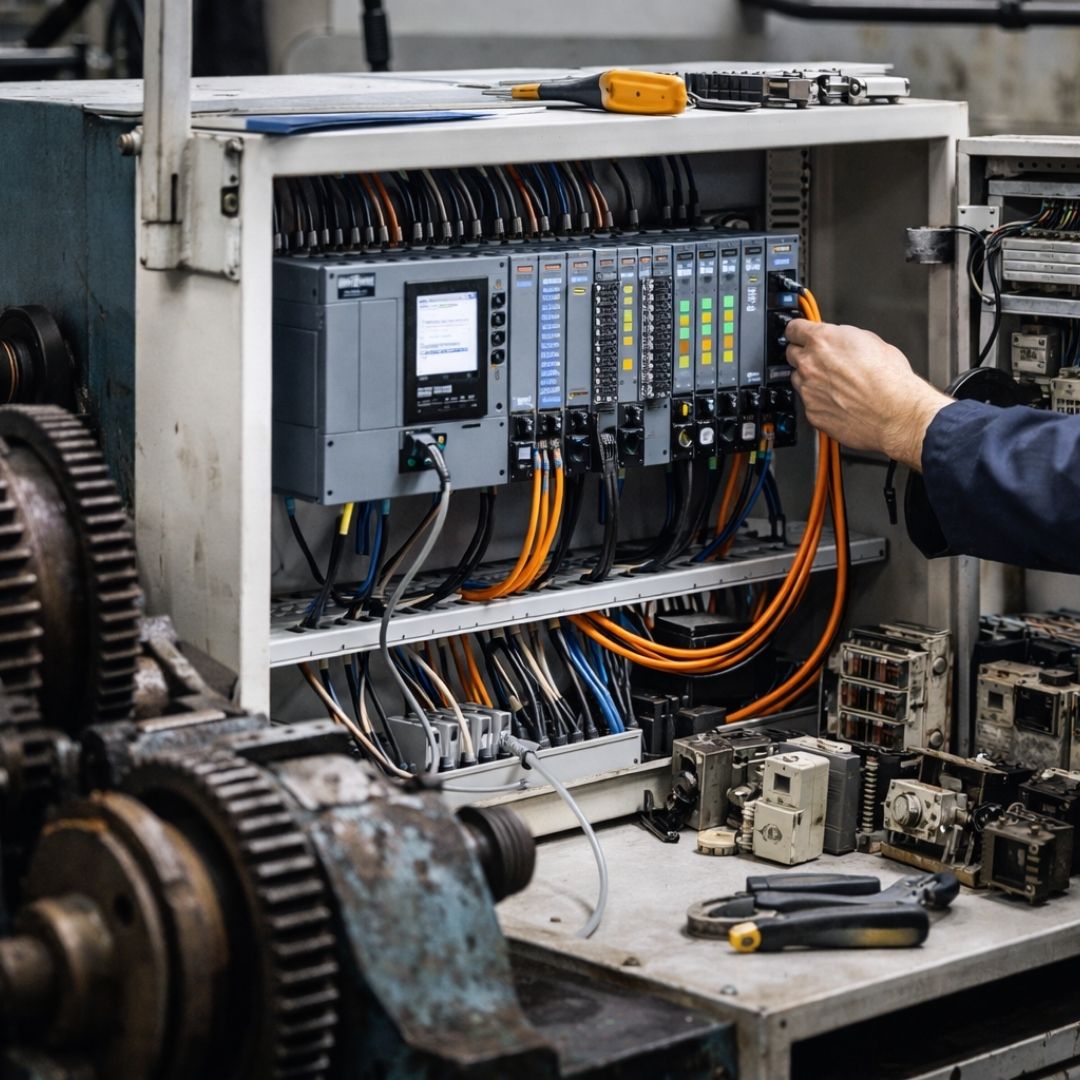
Automation is often the core of a retrofit. It may include replacing the PLC, HMI interface, variable speed drives, sensors, and industrial communication systems.
The integration of a programmable controller to modernize an industrial machine makes it possible to achieve more precise control, better connectivity, and clearer fault diagnostics.
Electrical Cabinets and Control Components
Electrical retrofit may include cabinet refurbishment, replacement of protections, contactors, terminals, wiring, power supplies, and ventilation systems.
Electrical components adapted for industrial modernization help improve installation reliability and reduce failures related to electrical aging.
Sensors, Instrumentation, and Measurement
Pressure sensors, temperature sensors, flow meters, load cells, or encoders are frequently replaced, recalibrated, or added during a retrofit.
Poor measurement can cause production variations or defects perceived as machine failures. This is why integrating industrial sensors into a retrofit is essential to improve process control.
Functional Safety
Safety is one of the priorities of an industrial retrofit. It may include updating emergency stops, safety light curtains, interlocks, mechanical guards, and access control systems.
A retrofit should never be limited to improving productivity: it must also reduce risks for operators and ensure operation compliant with current requirements.
Types of Industrial Retrofit
Light Retrofit
A light retrofit consists of modernizing a few targeted elements, such as an operator screen, a sensor, a drive, or part of the wiring. It generally involves a short shutdown and limited investment.
Complete Electrical Retrofit
This type of intervention includes electrical cabinet refurbishment, rewiring, and updating protections and control components.
Automation Retrofit
Automation retrofit concerns PLC replacement, program improvement, addition of diagnostic functions, and modernization of operator interfaces.
Mechanical Retrofit
Mechanical retrofit includes replacement of wear parts such as bearings, belts, transmissions, guides, motorization systems, or structural elements.
Full Retrofit
A full retrofit combines electrical, mechanical, automation, and safety interventions in order to deeply transform the machine’s operation.
Signs That a Retrofit Is Necessary
- Obsolete or difficult-to-replace components
- Repetitive breakdowns
- Frequent production stoppages
- Lack of clear diagnostics
- Excessive energy consumption
- Safety issues
- Quality variations or process instability
Industrial Retrofit Process
Initial Audit
The first step consists of analyzing the real condition of the machine, its breakdown history, its technical limitations, and the risks associated with its use.
Scope Definition
The next step is to determine the objectives of the project: improving safety, reducing stoppages, modernizing automation, increasing precision, or simplifying maintenance.
Engineering and Component Selection
This phase makes it possible to choose suitable components, design electrical diagrams, define the control architecture, and prepare integration.
Installation and Commissioning
Assembly, testing, and validation must be carried out under real operating conditions in order to guarantee that the modernized machine meets the defined objectives.
Documentation and Training
An effective retrofit must include diagrams, programs, manuals, configuration parameters, and the training required for technical teams.
Maintenance After Retrofit
A modernized machine remains industrial equipment that must be monitored regularly. Preventive inspections, alarm monitoring, historical analysis, and component verification help extend the benefits of the retrofit.
Maintenance and upgrading of industrial equipment therefore play a key role in ensuring machine availability after modernization.
Cost of an Industrial Retrofit
The cost depends on the complexity of the machine, the number of components to replace, engineering hours, production downtime, and the desired level of automation.
The direct cost of components is only one part of the analysis. In many cases, the most important factor is the cost of production downtime required for the intervention.
Common Mistakes During a Retrofit
- Treating only the symptoms without identifying the real cause
- Underestimating safety
- Failing to document modifications
- Ignoring mechanical problems
- Choosing components that are difficult to maintain
- Failing to train operators and technicians
Retrofit and Used Machines
Retrofit is particularly important in the used industrial machinery market. It makes it possible to transform old equipment into reliable, productive machines adapted to current needs.
Before purchase, it is recommended to analyze the mechanical condition, electrical cabinets, parts availability, PLC programs, diagrams, and maintenance history.
Conclusion
A well-designed retrofit transforms an existing machine into a more reliable, more modern asset better suited to current production.
It makes it possible to avoid heavy investment in a new machine while improving safety, performance, maintainability, and equipment availability.
The key to a successful retrofit lies in a realistic machine analysis, a clearly defined scope, and coherent integration between mechanics, electricity, automation, and maintenance.