 Recycling and pelletizing
9 types
Recycling and pelletizing
9 types
 Extrusion
8 types
Extrusion
8 types
 Mixing equipment
2 types
Mixing equipment
2 types
 Conveying and storage
8 types
Conveying and storage
8 types
 Drying and cooling
2 types
Drying and cooling
2 types
 Cutting, pressing and packaging
4 types
Cutting, pressing and packaging
4 types
 Plastic processing machinery
3 types
Plastic processing machinery
3 types
 Electromechanical equipment
7 types
Electromechanical equipment
7 types
 Miscellaneous machinery
11 types
Miscellaneous machinery
11 types
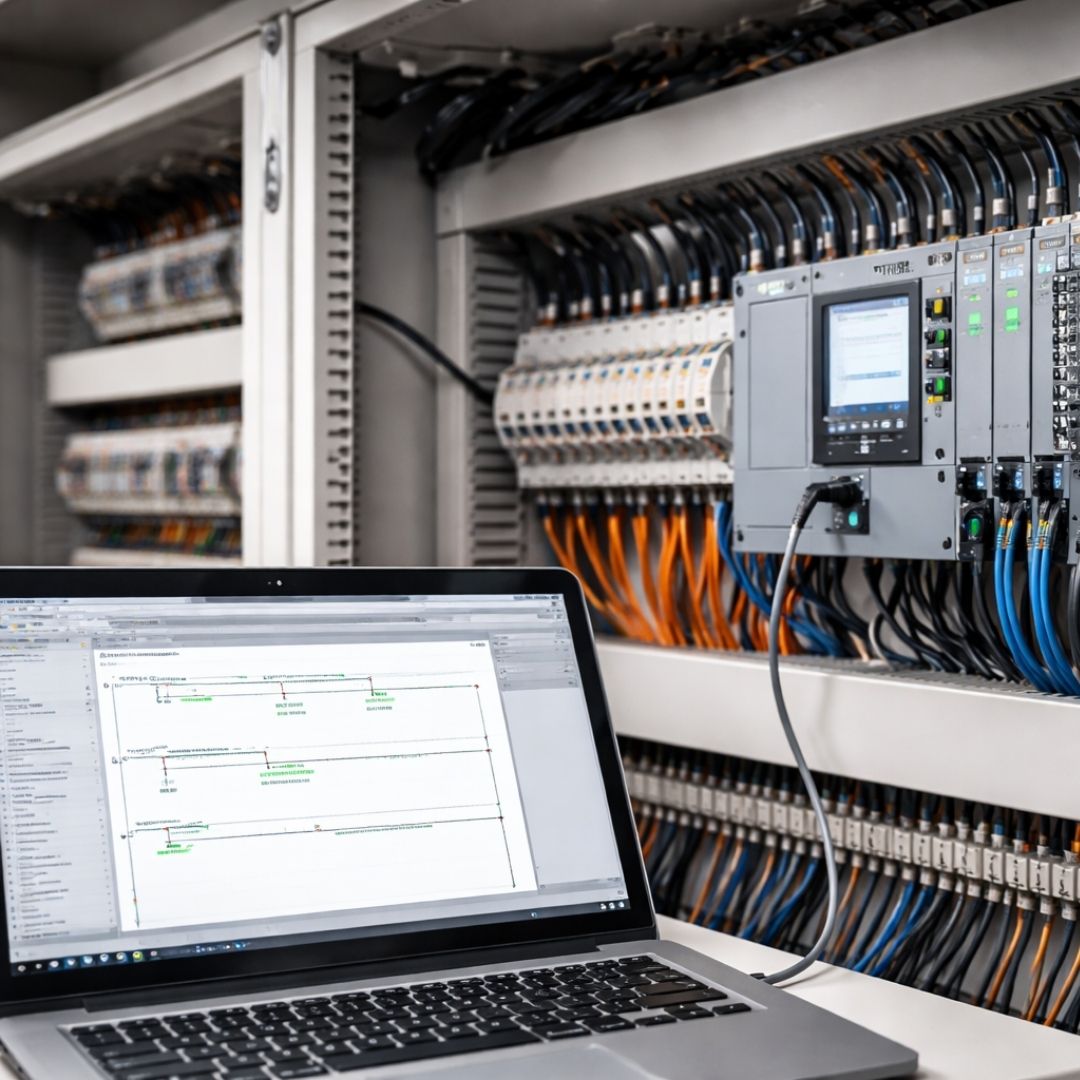 Industrial PLC: Complete Guide to Modern Automation
The industrial PLC is a central element of modern automation. It is used in almost all industrial machines, from simple equipment to complex production lines.
Understanding its operation, role, and applications is essential for machine manufacturers, technicians, and production managers. In today’s industrial environments, industrial sensors used with programmable controllers also play a fundamental role in ensuring precise process control.
What Is an Industrial PLC?
An industrial PLC is an electronic controller designed to automate industrial processes in a reliable and repeatable way.
It receives signals from sensors, analyzes them according to a program, and then controls actuators such as motors, cylinders, or conveyors.
Replacement of Traditional Systems
The PLC replaces old relay-based systems, offering greater flexibility, reliability, and ease of maintenance. This evolution has profoundly transformed industrial machine automation across all manufacturing sectors.
Meaning of PLC and Programmable Logic Controller
PLC stands for Programmable Logic Controller.
The term refers to the same equipment used in industrial automation systems.
Why “Programmable”?
The term reflects the system’s ability to make automatic decisions without continuous human intervention.
How Does a PLC Work?
A PLC operates according to a continuous cycle called the scan cycle:
- Reading inputs
- Executing the program
- Updating outputs
This cycle repeats extremely quickly in order to ensure real-time control of industrial equipment.
Main Functions
- Timers
- Counters
- Control logic
- Safety interlocks
- Alarm management
- Machine-to-machine communication
PLC Components
CPU
The CPU executes the program and manages memory as well as system diagnostics.
Inputs and Outputs
Inputs receive signals from sensors and outputs control industrial actuators.
Expansion Modules
These modules allow the PLC to adapt to more complex machines or scalable production lines.
In many cases, these systems require different electrical components for industrial automation in order to ensure reliable and safe operation.
Types of PLCs
Compact PLC
Suitable for small machines with simple functions and a limited number of inputs and outputs.
Modular PLC
Used for complex systems requiring greater flexibility and expansion possibilities.
Programming Languages
Ladder Logic
The graphical Ladder language is the most widely used in industry thanks to its simplicity for reading and maintenance.
Structured Text
This language is used for complex calculations and advanced algorithms.
Instruction List
Although older, this language is still present in certain industrial systems.
Industrial Communications
- Modbus
- Profibus
- CANopen
- Industrial Ethernet
These protocols allow PLCs to communicate with operator interfaces, variable speed drives, and supervisory systems.
PLC, SCADA, HMI, and DCS
- PLC: machine control
- SCADA: global supervision
- HMI: operator interface
- DCS: management of complex industrial processes
PLC Installation
Proper installation requires clean wiring, good ventilation, and protection against electrical interference.
The quality of installation directly influences the reliability of automated systems and reduces the risk of failures.
PLC Maintenance and Diagnostics
Programmable controllers require regular inspection and maintenance operations in order to avoid production interruptions.
Specialized technicians must master the diagnostics and maintenance of industrial PLCs to ensure the proper operation of equipment.
Industrial PLC Brands
- Siemens
- Schneider Electric
- Omron
- Mitsubishi Electric
- Allen-Bradley
Each manufacturer offers solutions adapted to different levels of automation and industrial complexity.
Modernization and Retrofit
An obsolete PLC can cause frequent stoppages, maintenance difficulties, and compatibility issues.
Industrial machine retrofit with programmable controllers makes it possible to improve performance, safety, and connectivity of existing equipment without completely replacing the machine.
PLC Applications in Plastic Recycling
In plastic recycling lines, the PLC controls shredders, extruders, conveyors, and washing systems.
It also manages temperatures, motors, alarms, and production speeds in order to ensure a stable and optimized process.
The integration of smart sensors and supervisory systems now makes it possible to improve traceability and energy efficiency in industrial installations.
Conclusion
The industrial PLC is the heart of modern automation. It improves productivity, safety, and reliability of industrial systems while simplifying machine maintenance and upgrades.
Thanks to technological advances, programmable controllers continue to evolve toward more connected, intelligent solutions adapted to the requirements of Industry 4.0.