 Recycling and pelletizing
9 types
Recycling and pelletizing
9 types
 Extrusion
8 types
Extrusion
8 types
 Mixing equipment
2 types
Mixing equipment
2 types
 Conveying and storage
8 types
Conveying and storage
8 types
 Drying and cooling
2 types
Drying and cooling
2 types
 Cutting, pressing and packaging
4 types
Cutting, pressing and packaging
4 types
 Plastic processing machinery
3 types
Plastic processing machinery
3 types
 Electromechanical equipment
7 types
Electromechanical equipment
7 types
 Miscellaneous machinery
11 types
Miscellaneous machinery
11 types
 What Is an Extruder (or Extrusion Machine)?
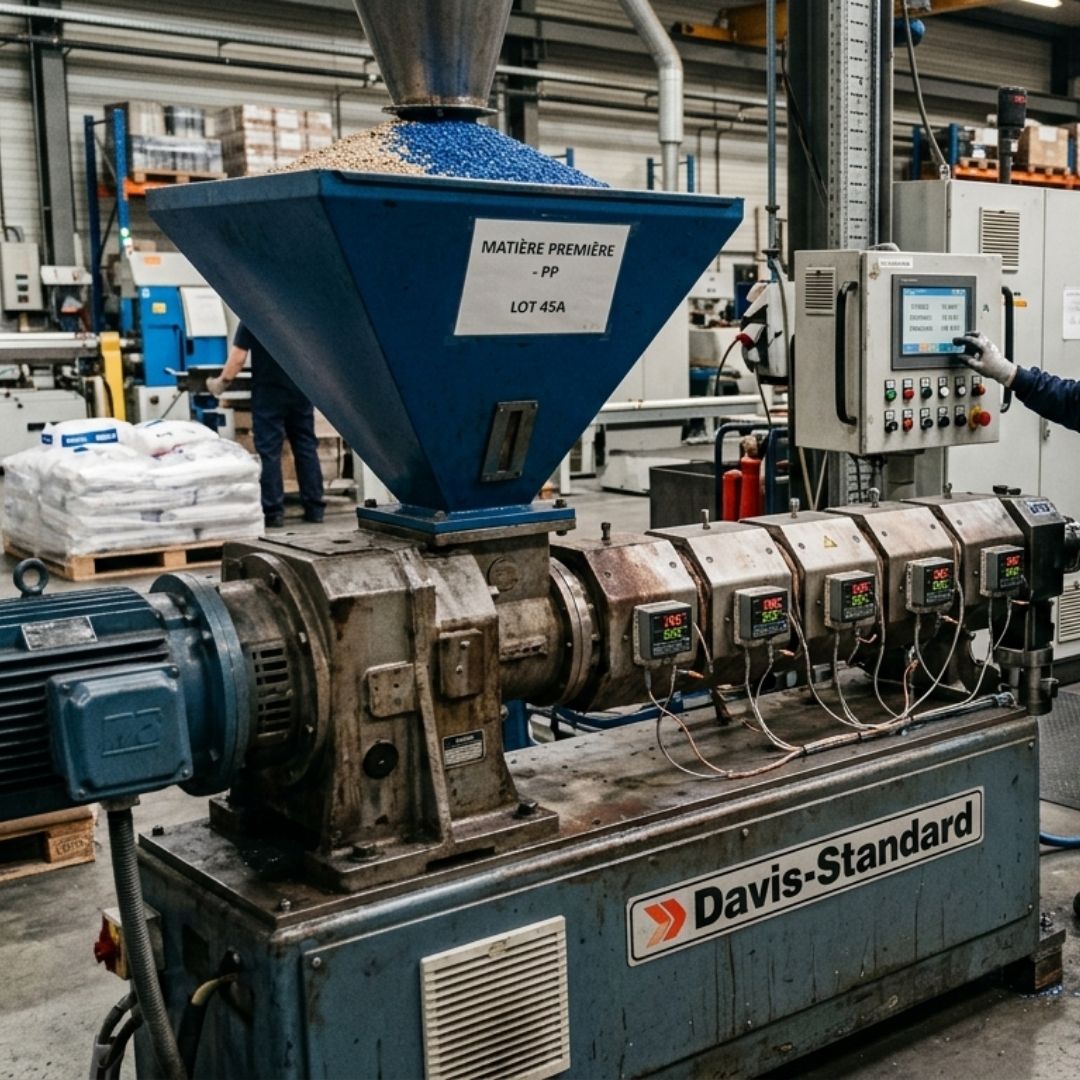
An extruder is a machine designed to transform thermoplastic materials into continuous products through the extrusion process. In its most technical form, it melts the polymer, homogenizes it, and pushes it under pressure through a die that defines its final shape.
In simpler terms, an extruder is the core machine of the plastics industry: it transforms solid raw materials into continuous and uniform products such as pipes, profiles, films, sheets, and recycled pellets.
The term “extruder” often refers specifically to the screw and barrel assembly, while “extrusion machine” generally designates the complete production line including the motor, hopper, heating zones, pulling systems, cooling equipment, and cutting units.
Extrusion is a continuous process, which allows very high production rates compared with discontinuous technologies such as plastic injection molding.
In the polymer processing industry, used plastic extrusion machines play a central role in the manufacturing of technical and recycled plastic products.
How Does an Extruder Work?
1. Feeding and Material Dosing
The process begins inside the hopper, where the plastic material is introduced in the form of pellets, flakes, regrind, or recycled plastic material. Gravimetric or volumetric dosing systems ensure stable and controlled feeding.
2. Melting and Plasticizing
Inside the barrel, the screw transports the material while generating friction and heat. The plastic progressively melts and becomes a homogeneous molten mass.
The different screw zones — feeding, compression, and metering — are specifically designed to optimize melt quality and prevent polymer degradation.
Single-screw extruders for plastics are especially common for standard applications such as films, pipes, and profiles because of their simplicity, reliability, and robustness.
3. Shaping Through the Die
Once melted, the plastic is pushed through a die that gives the material its final shape: pipe, profile, sheet, film, or technical component.
The final product quality strongly depends on pressure stability, temperature control, and die design.
The extrusion die heads and profile calibration systems are essential for ensuring dimensional precision and product consistency.
4. Cooling and Calibration
The extruded product exits the die while still hot and must therefore be stabilized. It passes through water, air, or vacuum cooling systems.
Calibration tables, cooling tanks, and pulling units guarantee the final dimensional accuracy of the product.
5. Cutting and Finishing
Finally, the product is cut to the required length or wound into rolls depending on the application, such as films, pipes, or profiles.
What Is an Extruder Used For?
Manufacturing Plastic Profiles
Extruders are used to manufacture PVC, PE, or PP profiles used in windows, doors, construction systems, and technical industrial parts.
Lines dedicated to the extrusion of pipes and plastic profiles are widely used in the construction, agricultural, and infrastructure sectors.
Pipe Production
Extruders are essential for producing pipes used for water distribution, gas transport, electrical protection, and agricultural irrigation systems.
Film and Sheet Manufacturing
Extrusion also allows the production of plastic films, bags, food packaging, and sheets used in thermoforming applications.
Equipment specialized in plastic film and sheet extrusion enables continuous production with highly accurate thickness control.
Plastic Recycling and Pelletizing
In the recycling industry, extruders transform plastic waste into reusable pellets suitable for new industrial applications.
Extrusion and pelletizing of recycled plastics now play a major role in the circular economy and industrial waste recovery.
Compounding and Technical Materials
Twin-screw extruders are used to mix polymers, additives, mineral fillers, pigments, or reinforcing fibers in order to create advanced technical materials.
Types of Extruders
Single-Screw Extruder
This is the most common type of extruder. Simple, reliable, and efficient, it is widely used for profiles, pipes, and film production.
Twin-Screw Extruder
Twin-screw extruders are ideal for complex formulations, advanced recycling, and technical compounds because they provide superior mixing and homogenization.
Understanding the difference between single-screw and twin-screw extruders is essential when selecting a production line adapted to a specific industrial application.
Special Extruders
Certain extrusion machines are specifically designed for laboratory testing, high-viscosity materials, or specialized industrial applications.
Materials Used in Extrusion
Common Thermoplastics
The most commonly processed materials are PE, PP, PVC, PET, and ABS, each offering specific thermal and mechanical properties.
Recycled Materials
Extrusion plays a key role in transforming recycled plastics into new industrial raw materials.
Additives and Fillers
Additives such as UV stabilizers, pigments, flame retardants, or glass fibers are incorporated to improve the properties of the final product.
Filtration and Quality Control in Extrusion
The quality of the molten polymer is critical to avoid surface defects, impurities, or mechanical inconsistencies.
The filtration systems used in extrusion lines remove contaminants and improve production stability, especially in plastic recycling applications.
Advantages of the Extrusion Process
- Continuous and highly productive manufacturing process
- Great flexibility regarding shapes and materials
- Optimized production costs
- Excellent dimensional stability
- Compatibility with both virgin and recycled materials
Extrusion vs Plastic Injection Molding
Extrusion is mainly used for continuous products such as pipes or films, while injection molding is designed for manufacturing individual complex parts.
For example, to produce long PVC profiles, an extruder is used, whereas technical individual components are generally produced using injection molding machines.
How to Choose an Extruder
Essential Technical Criteria
- Screw L/D ratio
- Motor power
- Available torque
- Production capacity
- Type of processed material
- Filtration system
- Single-screw or twin-screw configuration
Material Compatibility
Certain materials such as PET require strict moisture control, while others such as PP may require higher processing speeds.
Optimization and Maintenance
Process Settings and Performance
Incorrect temperature or speed settings may create defects such as bubbles, black specks, or thickness variations.
Preventive Maintenance
Regular maintenance of screws, heaters, sensors, and cooling systems is essential to guarantee stable production and avoid machine downtime.
Energy Efficiency
Modern extrusion machines integrate high-efficiency motors and intelligent control systems to reduce energy consumption.
Conclusion
The extruder is one of the most important machines in the plastics industry. It enables continuous, flexible, and highly efficient production while also playing a central role in recycling and the circular economy.
Whether manufacturing films, pipes, profiles, or recycled pellets, extrusion technologies remain essential in modern plastic processing lines.