 Recycling and pelletizing
9 types
Recycling and pelletizing
9 types
 Extrusion
8 types
Extrusion
8 types
 Mixing equipment
2 types
Mixing equipment
2 types
 Conveying and storage
8 types
Conveying and storage
8 types
 Drying and cooling
2 types
Drying and cooling
2 types
 Cutting, pressing and packaging
4 types
Cutting, pressing and packaging
4 types
 Plastic processing machinery
3 types
Plastic processing machinery
3 types
 Electromechanical equipment
7 types
Electromechanical equipment
7 types
 Miscellaneous machinery
11 types
Miscellaneous machinery
11 types
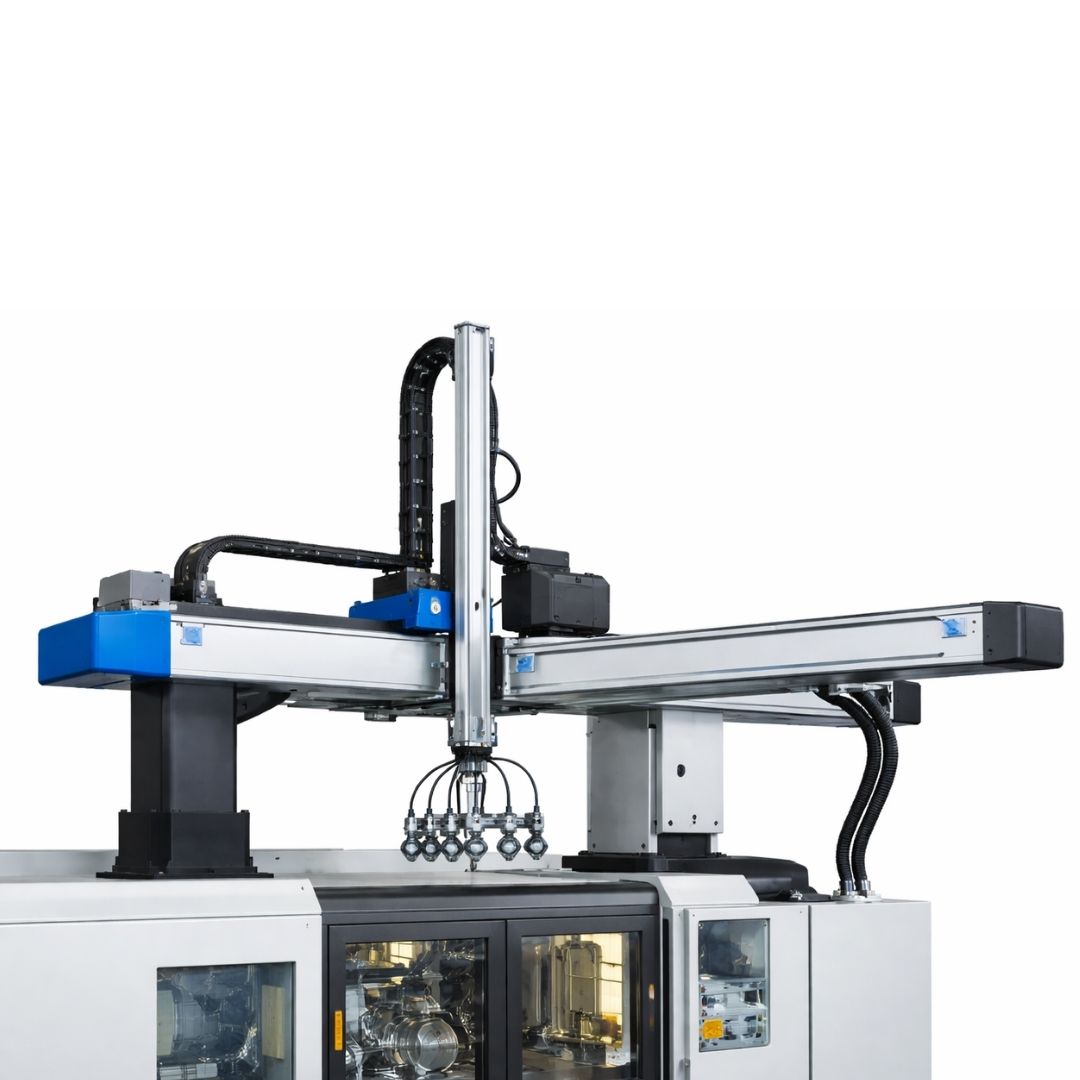 In industrial automation, the Cartesian robot is considered a reliable, precise, and highly practical solution for performing repetitive movements in stable production environments. It is based on simple mechanics, controlled linear axes, and high repeatability, making it particularly suitable for modern production lines.
In the plastics industry, this type of robot is often integrated into automated production cells, particularly alongside automated plastic injection equipment, in order to handle part removal, transfer operations, unloading tasks, or production cycle optimization.
Cartesian Architecture in Industrial Automation
Operating Principle
A Cartesian robot operates through orthogonal linear axes, generally X, Y, and Z. Each axis moves independently along a straight trajectory, simplifying programming, system control, and maintenance operations.
Unlike articulated robots, Cartesian robots do not require complex kinematics. This direct mechanical architecture reduces positioning errors and allows more predictable and stable movements.
Structural Advantages
The Cartesian structure provides strong mechanical stability. Each movement is easy for technical teams to understand and monitor, which simplifies integration into existing production lines and reduces the need for advanced operator training.
Differences Between Cartesian Robots and Other Industrial Robots
Articulated robots use multiple rotational joints to reach a given position. A Cartesian robot, on the other hand, moves exclusively on linear axes. This difference reduces mechanical complexity and improves repeatability for simple or repetitive industrial tasks.
Its spatial flexibility is more limited than that of articulated robots, but this limitation becomes secondary in processes where trajectories remain regular, such as handling, loading, unloading, transfer operations, or palletizing.
Why Cartesian Robots Remain Widely Used
Cartesian robots remain popular because they combine simplicity, robustness, and operational efficiency. In industrial environments where production cycles are repetitive, they can offer better profitability than more complex robotic systems.
They are also integrated into many plastic processing operations, where the automation of plastic molding processes helps improve consistency, productivity, and the quality of manufactured parts.
General Operating Principles of a Cartesian Robot
Movement Along the X, Y, and Z Axes
Movements are performed along three main axes:
- The X axis for longitudinal movement
- The Y axis for transverse movement
- The Z axis for vertical movement
Each axis has its own guidance and transmission system. This allows speed, acceleration, and positioning to be adjusted independently according to the needs of the industrial process.
Control and Repeatability
Repeatability is one of the main advantages of the Cartesian robot. Through the use of encoders, servo motors, and precise control systems, every movement can be reproduced consistently over thousands of production cycles.
This level of precision is especially valuable in applications where movement consistency directly influences the final product quality.
Degrees of Freedom
The number of degrees of freedom depends on the number of installed axes. A simple configuration may operate on two axes, while a standard industrial system generally uses three axes to work within a complete volumetric space.
Working Area and Operational Structure
Definition of the Working Area
The working area of a Cartesian robot is determined by the axis lengths and the mechanical structure of the system. This configuration allows the intervention area to be precisely dimensioned according to the machine, production line, or automated cell.
Common Configurations
- 2-axis systems for simple flat-surface applications
- 3-axis systems for volumetric industrial operations
- Gantry structures for large working areas
- Automated handling and palletizing systems
Comparison with Other Robot Architectures
The Cartesian robot provides a fully usable working area, but it generally requires more linear space than a compact robot. This compromise is usually acceptable when precision, stability, and repeatability are the main priorities.
Main Components of a Cartesian Robot
Mechanical Structure and Linear Guides
The mechanical structure ensures the overall rigidity of the system. Depending on load, speed, and precision requirements, it may be manufactured from reinforced aluminum or steel.
Linear guides guarantee smooth movement and directly contribute to positioning accuracy.
Drive and Transmission Systems
Movements may be generated through different systems:
- Ball screws
- Belts
- Rack-and-pinion systems
- Linear drives
The choice depends on the required precision level, payload capacity, and production speed.
Control System
The robot is generally controlled through a programmable logic controller (PLC), allowing synchronization with other equipment on the production line. This integration is essential in automated manufacturing environments.
End Effector
The end effector may consist of a gripper, vacuum cup, mechanical handling device, or a dedicated tool. Its selection depends on the type of part being handled and the operation being performed.
Industrial Applications of Cartesian Robots
Part Handling and Transfer
Cartesian robots are frequently used for machine loading and unloading, transferring parts between workstations, or positioning components with high precision.
Automation of Repetitive Tasks
They reduce human variability in repetitive operations, improving production consistency and minimizing errors associated with fatigue or manual handling.
Integration into Plastic Processing Operations
In plastic processing plants, Cartesian robots can complement different types of industrial equipment. They are highly relevant in injection molding cells, but also in environments related to industrial automation in plastic extrusion, where transfer and handling operations must remain repeatable and controlled.
To better understand the environments in which these systems are integrated, it is useful to know the main industrial machines used in plastic processing.
End-of-Line Operations and Palletizing
Cartesian robots are also used for packaging, stacking, wrapping, and palletizing operations at the end of production lines. Their mechanical stability ensures reliable operation over long production periods.
Advantages and Limitations
Advantages
- High movement repeatability
- Simple programming and control
- Easier maintenance
- Good integration into existing production lines
- Controlled investment cost compared with more complex robotic solutions
Limitations
- Lower spatial flexibility than articulated robots
- Requirement for sufficient linear space
- Less natural adaptation to complex trajectories
Cost and Decision Criteria
The cost of a Cartesian robot mainly depends on:
- Number of axes
- Structure dimensions
- Payload capacity
- Required precision level
- Degree of customization
The choice between a standard solution and a custom-designed system must be made according to the process requirements, production rate, available space, and maintenance constraints.
Strategic Role in Industrial Automation
The Cartesian robot plays an important role in industrial automation because it efficiently addresses the needs for repeatability, precision, and operational stability. It improves production line performance without introducing unnecessary mechanical complexity.
In the plastics processing sector, it is part of a broader strategy focused on optimizing plastic product manufacturing equipment, reinforcing productivity, production consistency, and the quality of automated operations.